Thursday, May 26, 2011

White Sulphur Springs, Montana

It’s hard to believe that a person could suffer from S.A.D.D. while in Big Sky country but it is possible, take my word for it.   Our stay in White Sulphur Springs was spent almost entirely under leaden skies with clouds hovering so close to the ground that they obscured our fine view of the Big Belt Mountains.  A combination of almost constant rain and melting snow has swollen many of the rivers and streams in Montana to flood stage.  Although we weren’t affected by it, at one point a long portion of I-90 east of Billings was closed due to floodwaters along the Yellowstone River.  The Smith River, which originates near White Sulphur Springs and is a favorite with serious “floaters”, has already claimed one victim this season.

I had a vague memory of White Sulphur Springs but it turned out to be totally inaccurate.  I was recalling a large white Victorian-era hotel with lots of shade trees.  The truth was closer to a ‘50s era motel with not so much as a shrub much less trees.  It is entirely possible I had White Sulphur Springs and Warm Springs mixed up…which means it wasn’t a Victorian-era hotel I was recalling.  These days White Sulphur Springs is no longer a bustling town midway between Helena and Harlowtown but rather a cluster of small homes, several bars and restaurants and a few miscellaneous businesses, most having more than one purpose, i.e. the state liquor store/shoe store/boutique. 

The Conestoga Campground was our home for six days.  We had almost all the creature comforts except that t.v. reception came and went at the whim of the weather and the repeater station.  We met some really nice folks and had a good time in spite of the depressing weather.  And we were able to watch the final episode of “Dancing With The Stars” thanks to the owner keeping the clubhouse open late.  We all appreciated it.

Our arrival was just a bit too early and some of the area attractions weren’t open for the season.  Memorial Day is the magic day apparently.  However, the Meagher County Historical Society Museum, known as The Castle, was open for business and we were given an interesting escorted tour.  Castle Photographs were not allowed but there are several of the interior on their website.   A new structure to one side of The Castle houses a collection of donated items from area families, including a fascinating typewriter manufactured by the Blickensderfer Typewriter Company of Stamford, Conn.   Howie noticed it did not have a QWERTY keyboard and that a cylinder was employed instead of keys, very similar to the much later IBM Selectric.  A good description and an animated photo of the cylinder in action are available on an informative website we found.  We later learned that the fonts could be changed by changing the cylinders.  The model on display is the  “Blickensderfer 8”, which was also ahead of its time in that it incorporated a tabulator system.

We had picked up a brochure for the Bair Family Farm Museum indicating it was open several days a week during May and September, daily Memorial Day to Labor Day so, in spite of rainy weather, we took of for Martinsdale, a 30+ mile drive over hill and dale.  We should have called first because it had not yet opened for the season, in spite of what the brochure said.  On the drive over we saw no other vehicles going in our direction and only a few headed the opposite way.   And we learned an important lesson – a phone call in advance saves time in the long run.

Sunset WSS

In spite of the fact that the sun made only brief appearances during our stay, it did manage to produce several spectacular sunsets.  As it sat, the sun peeked under the dome of heavy clouds and created all sorts of interesting shapes and colors.  We even managed to enjoy one Happy Hour with some of our neighbors as the sun disappeared over the horizon.,.of course, we were all bundled up in heavy sweatshirts and jackets!

Swallow The Smith River flows nearby and the campground has a small pond so the Mayflies were hatching.  At evening the skies were filled with swallows darting about enjoying a feast.  These handsome little birds had already ousted the Western bluebirds from their boxes and established themselves all along the perimeter of the campground.

It was raining so hard the day we left White Sulphur Springs that we didn’t even go around to say formal goodbyes to all the folks we’d met.  We took U.S. 12 to Helena, along a stretch known as the Lewis and Clark Scenic Highway through the Big Belt Mountains.  I’m sure it’s a beautiful drive in good weather.  The road is quite narrow, with no shoulders, and Deep Creek was running fast and furious, sometimes right at the road’s edge.  Again, there was very little traffic and only a few isolated ranches and cabins until we got to Townsend.

We’ve hunkered down in Helena to wait for an improvement in the weather and to be off the road for Memorial Day.

Thursday, May 19, 2011

Bozeman, Montana

Bozeman is a delightful little city, sandwiched in a flat spot between the Bridger and Gallatin ranges.  It’s big enough to have a Costco and small enough to get around in easily, two features which endear a city to me.   The downtown area has several blocks of small shops and interesting cafes and seems to be always pleasantly busy.  Bozeman is not all that far removed from its rip-snorting wild west days but is now one of the fastest growing cities in Montana, high-tech and entrepreneurial.   With major ski destinations nearby, it has become a hub for the schussing  set and has the mini-mansions to prove it.

The town was named for John Bozeman, a frontiersman who established a short cut for travelers on the Oregon Trail that branched off in Wyoming and headed straight through Indian territory and into Montana.  Bozeman GraveThe natives took exception to the trespassing and the trail became known as “the bloody Bozeman”.  John himself was a handsome fellow who met an untimely death in his early 30’s.   There is still some controversy over the cause of his demise – was he killed by a Blackfoot band on the Yellowstone River or was he done in by a jealous husband?  The truth will likely never be known but the official answer is carved on his tombstone here at Sunset Hills Cemetery.

The Pioneer Museum, housed in the former county jail, sports an interesting collection of memorabilia from the town’s earliest days, including a full feather head-dress found at the Little Bighorn the day after Custer made his last stand.  Unlike most “hanging trees” this jail features an indoor contraption (used only once) that takes up little space and looks almost modern compared with other devices for that purpose.

It was a crisp sunny day when we headed west to visit Madison Buffalo Jump State Park near Three Forks.  Madison Buffalo Jump The park has few explanatory signs, a lock-box for entrance fees and the jump.  And just about all the silence a body could handle.  “Remote” does not begin to describe the place and it’s hard to imagine the noise and confusion that must have accompanied the end of a tribe’s bison hunt. 

Somewhat less remote is the Missouri Headwaters State Park, not far from the town of Three Forks.  Madison River Here the Gallatin, Madison and Jefferson rivers come together to form the Missouri, which then heads north before making a dog-leg to the right and heading east.  The snowpack had only just begun to melt when we were there and the rivers were running at a good clip but not dangerously so.  Horses The river was just a great place to romp for this herd of horses; they were splashing around, having a grand time and enjoying a find spring day.  Standing on the bank, listening to the sound of water, brings to mind the Norman Maclean book “A River Runs Through It”.  It’s also easy to picture Lewis and Clark poling their pirogue, at least where the water is deep and smooth.  And, once again, the quiet was all-encompassing except for the river sounds.  There’s not much traffic here this early in the season.

Computer Collection

One of the quirkier museums we’ve ever visited is the American Computer Museum, housed in a corner suite of what can only be described as “a professional park”, mostly insurance offices and medical specialists, near the MSU campus.   The museum has room to display only about 6% of its collection but they have some fascinating items to show.  It can be a bit depressing to see devices you once thought of as highly advanced from a technology standpoint now viewed as “antiques”.  We were disappointed that a model of our first Xerox computer, or at least the daisy wheel printer, wasn’t  exhibited.

M on the Hill

I wanted to get a closer look at the big white “M”, a symbol dear to the hearts of Montana State University alums, so we drove out for a look-see.  It was an extremely windy day so we didn’t even attempt the steep trail up to the “M”.   Not that failing knees would have permitted it.  This leads me to wonder where the dividing line falls in Montana weather reports – one day was described as “breezy” and the next as “windy” but both made the coach rock and stirred up a bit of motion sickness just sitting in the car.  As near as we could determine,  “windy” is 1 mph stronger than “breezy”. 

From there we headed across town and out toward Four Corners then up into Gallatin Canyon going toward Big Sky.  We had no intention of going that far but were looking for something called “House Rock” which a local had told us was a sight to see when the river was running high and the water went over the rock and not just around it.  Rafters on the Gallatin We aren’t sure that this is House Rock but it was certainly fun to watch these rafters fairly flying downstream.  We saw one single-man raft flip over but the occupant soon righted himself and continued on to the pick-up point below.  There were spectators perched on rocks overhanging the river but we were content to watch from the safety of a nice solid highway pull-off.

Besides the ski areas of Big Sky and Bridger Bowl, Bozeman’s biggest attraction is The Museum of the Rockies, a fine facility on the MSU campus and one affiliated with the Smithsonian.  Montana has been a treasure trove of dinosaur bones and has active digs going on in various parts of the state.  Big Mike And those big bones have to be displayed somewhere, hence the museum.  We spent four hours roaming around, gawking at the exhibits.  There were models, of course, but many of the actual skeletons are displayed.  It’s almost too much to take in all at once which is probably why the admission fee is for a two-day pass.

In addition to the dinosaur exhibit, there is a nice collection of Native American artifacts.  The beadwork was especially interesting and it’s always fascinating to see such modern-looking designs on primitive pieces.  Photographs were not permitted in that section of the museum.

Bud-Wise-Err There’s also a large space for rotating exhibits and we were fortunate enough to arrive in time to see “Frogs: A Chorus of Colors”.  Many zoos and aquariums have displays of frogs and toads but this exhibit featured the brightest and most interesting of the species.  There were the gaudy poison dart frogs, with their electric colors.  and the long-nose horned frog which was hard to locate thanks to his looking pretty much like a dried up oak leaf.  But these were our favorites, the waxy monkey frogs, who reminded us of those fine fellows in the Budweiser commercials.  At first they appeared fake, never moving or changing expression (can frogs smile?) but finally one swallowed and I was finally convinced they were real.

And so we said farewell to Bozeman and moved on a bit north to White Sulphur Springs.  We’ll be reporting from here early next week.  Meanwhile, we can mention that from the front window of the coach we have a grand view of a herd of black Angus, the snow covered foothills of the Big Belts and the Smith River which is nearing flood stage.  Stay tuned.

Wednesday, May 11, 2011

Dillon, Montana

Our stop in Dillon was brief, selected only as a place-to-be over a weekend, but it turned out to be one of the more interesting places to spend three days, even with the lousy weather conspiring to keep us confined to the coach.  Our campground had all the comforts of home up to and including all the peace and quiet a body could handle.  But we were eager to get out and explore the area.

Saturday promised to be nice enough in Dillon but nasty-looking clouds (the sort that produce snow) were lurking about in the general direction we wanted to explore, south and west to visit Bannack State Park.  But by late morning the skies had cleared and we hit the road.  We didn’t encounter any snow, even at Badger Pass which tops out about 6200 feet.  The terrain is mostly rolling hills with long views to distant mountain ranges.  Very pretty.

As a state park, Bannack is most unusual.  It essentially comprises what used to be the entire gold-mining community of Bannack.  But unlike so many other ghost towns, this one has not been commercialized.  As a matter of fact, even the visitors’ center is closed during the “winter months”.  The streets were empty of all but a few hardy folks wandering about, poking into those buildings which were not padlocked.  It’s all on the honor system; visitors are expected to place park fees in a lock-box, borrow a brochure (or leave $2 if you want to keep it) and wander through the town at will.

Bannack's Main Street

One soon becomes aware of an enormous lack of noise, only the wind whistling and whispering (and sometimes yelling), the slight creaking of the boardwalk as you pace along the street, laughter coming from unseen children.   Even those who don’t believe in ghosts would find this place haunted.

Church

Gold was discovered along Grasshopper Creek in 1862 and within a year the town was established and in time reached a population of 3000 people, some good, some very bad.  The Methodist Church was the only structure specifically built for worship but I’m sure more than one miner left his gold in the collection plate of the Skinner Saloon.

The name Bannack came about thanks to an error on the part of the Federal Government.  The town fathers had intended to name the town after the Bannock Indians but thanks to a typo in Washington, D.C., the town went down in history as Bannack and became the first territorial capitol of Montana. 

Governor's Mansion

Here’s a picture of what remains of the original  Governor’s Mansion which burnt down in the early 1900’s.  Logs salvaged from the mansion were used to build this cabin.  Please note the sod roof.  The jail is no more imposing than the mansion.  It hardly looks capable of confining any but the meekest souls and Bannack was not known for its meekness.  It was headquarters for Henry Plummer and his gang – he was the chief law enforcement officer and the chief bad guy as well. 

Bannack Cemetary

The Bannack Cemetery is atop a hill north of town.  If anything, it is even more quiet than the town.  A few of the graves were sporting bright plastic flowers, a jarring contrast to the muted colors of the sagebrush and native grasses. 


We zoomed back to Dillon in hopes of touring the local historical society museum but it was closed for the weekend.  Instead we strolled around downtown, stopping at the library for their used book sale.  What a handsome building!  It’s made from local limestone with a quartet of gargoyles for garnish.

Library GargoyleThis devilish fellow struck our fancy.  The librarian told us that the stonecutter hired for the library project died before it was completed and that his wife finished the job.  It’s these intriguing little factoids that keep us poking around wherever we are.

Sunday, May 8, 2011

Provo, Utah – Pocatello, Idaho

Provo, Utah is a pretty little city pushed up against the Wasatch Mountains, which were snow-covered upon our arrival and even more snow-covered upon our departure.  But that’s another story.  On our first full day in town we stopped at the visitors’ center to gather whatever information we needed to make a thorough exploration of the area and were directed to the city library, a seamless grafting of old and new.  Behind the handsome old Brigham Young Academy sits the state-of-the-art new library so that both halves can be utilized together.  A stunning stained glass window separates the two. 
A librarian strongly suggested we attend the Carl Bloch exhibit at the BYU Museum of Art.  She was very helpful and tried to download tickets for us but there was some glitch in the website that prevented it.  So she suggested we just show up and act dumb (not difficult for us) and we’d be escorted right in.  Well, not exactly, but nearly so.  We arrived at the BYU campus, along with everybody else in Provo, and were told by the gatekeeper to check back at noon.
BYU Museum of Art Meanwhile, we scouted the Museum’s permanent collection which leans heavily on “Western art” including a large collection of paintings by Maynard Dixon.  They don’t have much in the way of “modern art” – thank heavens – but we were taken with this featured piece.   Modern art is supposed to remind you of something and this reminded us of the back seat of our car.  Except we just might have more books.  It would be a toss-up.

The  Bloch exhibit, which was nearing its end, had attracted a large crowd, apparently everyone was waiting for better weather to venture out.    BYU owns a number of Bloch etchings but the large altar pieces were on loan from various museums and churches in Denmark.  Some of the smaller paintings which were on exhibit showed a remarkable facility with light; the larger paintings seemed to me to be almost too commercial; perhaps because they’ve been used countless times as illustrations for religious texts. 
After wending our way through the art, we did a quick walk-about on the campus.  Ornamental fruit trees were in bloom and contrasted dramatically with the snow-covered mountains beyond. 
BYU Carillon The bell tower was pealing forth music across the campus as we climbed uphill toward the Monte L. Bean Life Science Museum, a space filled with beautifully mounted specimens of fish, birds and mammals.  An enormous Kodiak bear dominates its space and one hopes never ever to encounter one in real life – they’re scary enough when they’re dead!

Weather continued to be a problem and we had to scrub plans to drive up into Provo Canyon to view Bridal Veil Falls.  Instead we grabbed our Cabela’s gift cards and headed north to check out the goodies there.  Along the way we drove into and out of a number of “snow squalls”, not something we relish, and we were relieved to arrive back in Provo to relatively mild temperatures and partly sunny skies.  The next morning, however, was a total bummer.
Provo RiverWe may call our-selves “snowbirds” but that doesn’t mean we actually want to see the stuff!  Thankfully it melted off by noon, leaving us with a relatively pleasant day.


On Sunday we went out in search of a newspaper which led us to a shopping mall south of downtown Provo.  It was a sizeable mall, with all the usual anchor stores.  Most of the smaller stores were closed and if you’d set off a cannon down the middle of the mall chances are you wouldn’t have hit anybody.  It struck me as a fine idea to get a haircut at a franchise salon at this all-but-deserted mall; after all, the two stylists were just sitting there with nothing much to do.  Bad idea.  It’s one of the worst haircuts I’ve ever had and I can only hope that it grows out soon. 
We left Provo on a bright Monday morning and drove northward on I-15 through a broad handsome valley with snow-topped mountains on either side.  It was a stress-free and enjoyable trip, even if somewhat longer than we usually make. 
When we arrive in a city or town for the first time, our first stop is generally the Visitors’ Center and Pocatello was no exception.  A sign on the door indicated the center would be open on Friday, Saturday and Sunday.  Unfortunately we planned to leave town on Friday so we were left to our own devices (and our GPS) to find the local attractions.  Because we had grocery shopping to do, we just poked around Old Town, hit the thrift stores in search of books and learned that the best wine prices in town were to be had at…are you ready for this…Ace Hardware.  They even had a wine-tasting schedule for the first Tuesday of the month….which happened to coincide with our arrival.  However, if wine samples were being doled out, we missed it.  Perhaps they were hidden behind the plumbing supplies on one side or the snowmobiling gear on the other. 
The Pocatello Zoo is on the reciprocal list so we headed off early on Wednesday to check it out.  The location is attractive but, as might be expected, they have very few exhibits…some mountain sheep, a lethargic bear and some bison who refused to take their faces out of the feeders.  Not every zoo can be St. Louis!
After the zoo we stopped at the Bannock County Historical Museum and Ft. Hall Replica.  Bannock County Museum The fort was closed, being open only on weekends during the “winter” months (and winter lasts at least six months in Idaho) but we did do a tour of the museum.  After that we trekked to the Idaho State University campus to check out their Museum of Natural History. 

ISU Natural History Museum Most of their gem and mineral collection was in storage with only a few major pieces on display but I was much taken with a 5200+ caret hunk of quartz which had been cut by a master, leaving it with more than 300 facets and enough glitter to shame the finest diamonds. 
As we were leaving the museum, we struck up a conversation with the gift shop manager who gave us tons of information about the area and admitted to his sideline business of coffee roasting.  Hearing that, we took off for the mall to seek out one of his products at a co-op of local crafters.  And thus we came into the possession of a pound of Mexico Oaxaca Pluma Tres Oros prepared by Bill’s Beans (www.billsbeans.com).
On Thursday we got an early start and scoped out the book sale at the downtown Pocatello library  then headed north on I-15 to the Ft. Hall Shoshone-Bannock Reservation.  We’d been told The Clothing Store had a large selection of seed beads and I was hoping to glom onto the size 8’s that I need for a project.  Unfortunately, the sizes jumped from 11 to 6 with no stop at 8 and so we soon wandered across the street to the Shoshone-Bannock Tribal Museum.  A small facility, managed by a charming lady named Rosemary Devinney, we were given a crash course in Shoshone-Bannock history and folkways.  It was here that we first became aware of a local celebrity named Randy’L Teton who was the model for the Sacagawea gold dollar introduced in 2000. 
Continuing north, we arrived around lunchtime in Blackfoot, the center of Idaho’s potato production and home to the Idaho Potato Museum. 
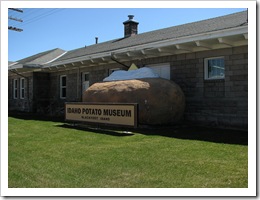
Idaho Potato Museum
Housed in a former railroad station, the museum details the history of the white potato.  First grown in South America, the potato was exported by the Spaniards to Europe and then imported back to the United States.  Initially, the potato was avoided by the upper crust in Europe because it was thought to be poisonous.  Which it is, except for the underground tubers.  The nickname, SPUD, was coined from an English organization,  The Society for the  Prevention of  Unwholesome Diets. 
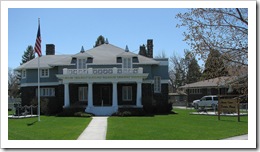
Bingham County Museum
Our final stop in Blackfoot was the Bingham County Historical Society Museum, housed in a grand old mansion built by a wealthy merchant for his Southern belle bride.  The house became the center of society in early Blackfoot and now contains many artifacts peculiar to that era.  The furniture is all “of the period” and is in remarkable condition, including a rocking chair built by Brigham Young and several pianos and organs with their keys in fine shape given their advanced age. 
We are currently cooling (literally) our heels in Dillon, Montana where the weather is overcast and chilly.  We have our fingers crossed that it will be nice enough in the next day or two so we can make the run to Bannock State Park to see the remains of that ghost town.  Stay tuned for all the details.

Monday, April 25, 2011

Hurricane, Utah

As we sit here on our final evening in Hurricane (or are we really in the ghost town of Harrisburg?), the rains have resumed and the mountains just to the west of us seem to have acquired more snow on their upper regions.  It has been a visit both busy and laid back and we’ve enjoyed our stay here.  This campground, while small and somewhat cramped, has all the comforts of home plus a grand view of the red rock cliffs and mountains beyond and the wider area boasts plenty to keep the sightseer busy.  Right at the entrance to the campground is the stone remains of one of Harrisburg’s original homes, up to and including the trusses to support the long-gone roof.  The vicinity sports other foundations or walls from the homesteads.  After being flooded out twice, the pioneers packed up and moved to higher ground; those who had built wooden structures dismantled them and took them along, trees being in very short supply in this part of Utah.

The town of Hurricane, somewhat further east, was named by an early settler whose buggy roof was blown off in a whirlwind. It’s pronounced HER-a-kin, not Her-a-CANE, which rhymes nicely with her right-next-door town of LaVerkin. 

Our first order of business was to check out the city of St. George, poking our noses into thrift shops in search of books and whatever else struck our fancy.  It’s a very clean city and seems untouched by the current downturn in the economy – shops were busy, traffic was heavy and we saw few vacant storefronts, unlike so many cities we’ve seen lately.  There appears to be lots of new housing and most homes seem to be occupied. 

Zion National Park is within easy driving distance of Hurricane and we made the trip on Wednesday for a revisit to enjoy the isolated beauty of the park.  It wasn’t so isolated this time; our visit coincided with the dreaded Spring Break so the park was awash with tourists, many dragging small screaming children.  Given that there is only one paved road to the interior of the park, visitors are asked to park either in the town of Springdale or at the Visitors Center and take one of the shuttles into the park itself.  The shuttles run constantly so we hopped aboard, rode all the way to the furthest point and then made all the stops on the return trip to the parking area.

There are many species which call the park home but  most were likely put off by the hordes of wandering tourists.  The ground squirrels were busily at work striking too-cute-for-words poses in hopes of shaking down the tourists for tidbits.  They can be very pushy and as the NPS signs indicate, they will bite.

Turkey

Along the route we spotted this tom strutting his stuff on a small island in  the Virgin River.  The object of his affection, a plain-jane hen, could not have been less impressed.  She was much too busy pecking in the dirt for lunch.  We also saw a pair of condors riding the thermals in search of prey. 

Climbers Or waiting for one of these climbers to take a tumble.  Yes, those are people clinging to those sheer rock walls.  (Double click on the photo and zoom in to see the climbers


The Virgin River was running hard and fast but seemed well-confined within its banks.  IMG_9019 We overheard someone say that the mountains which feed it are still heavily covered with snow and that the major snow melt is still some weeks away.  And so the river will likely get higher and faster before spring is over.

As noted, the park was crawling with tourists, many of them very inappropriately dressed for mountain trails.  Young girls were tripping along in their sequined flip-flops and bikini tops while more mature women were sporting Crocs in a variety of glow-in-the-dark colors. 

Only a few miles from our campground is the ghost town of Silver Reef, once a boom town of 4000 souls.  All that remains is the handsome Wells Fargo Building, now a museum and gift shop and the partial remains of a few other sandstone buildings.  The docent at the museum told us that Silver Reef was one of only two places worldwide where silver ore was found in sandstone.  The town went from boom to bust when the price of gold fell and folks just disassembled their homes and carted them off to greener pastures.  The view of the valley from atop Silver Reef is nothing short of magnificent. 

Silver Reef Vista The majority of the land is publicly owned but there is a thin strip of land leading to the mines that is now privately owned and sports some fairly elaborate McMansions.  Only the wind provided the soundtrack.

On the way back to the campgroCCC Camp - Leeds,  UTund we stopped in Leeds to explore the site of an early CCC Campground.  The young men’s handiwork is evident in many of Utah’s state and national parks, including the engineering wonder of the tunnel on the highway between Zion and Bryce Canyon.


The St. George Arts Festival is a highly respected gathering of artists and craftspeople from all around the West.  We decided to visit on Friday in hopes the crowds would be smaller…and they were…but it was still very well attended.  The majority of booths featured paintings and photography with only a handful displaying other art forms.  Such beautiful things, such talented people….for a brief moment I wished we had a house to put them in. 

There’s a Costco in St. George so we had to attend the “buffet” on Saturday.  There were too many pickled things and not enough sweets to suit me.  But we managed to fortify ourselves enough to roll on up I-15 to Kolob Canyon, one of the sections of Zion National Park which is only accessible from well west of the rest of the park.  Unfortunately it was overcast and so the contrast between sage-green plants and red rocks was not as striking as in bright light.  Kolob Canyon was also crowded with tourists, all the trailhead parking areas were filled and  we weren’t inclined to spend a lot of time.  There were still traces of snow in some of the higher elevations and when it began to rain on the trip back down to the valley, we thought perhaps there’d be a bit of snow.   We were spared that dubious thrill.

Saturday evening the campground had entertainment in the clubhouse, an energetic singer named Gayle Louise.  She was warmly received by the attendees.  During the performance we made the acquaintance of some of our fellow campers and ended the evening sharing dessert and drinks with them around a campfire . 

Our next stop is Provo where the weather is predicted to be anywhere from chilly to downright cold.  Stay tuned to find out if we end up amusing ourselves by building snowmen.

Thursday, April 21, 2011

Bullhead City, Arizona – Adios Arizona

As evident from our most recent posting, we were having some fairly severe issues with the coach and coping as best we could.  But I’m very pleased to report that everything has been resolved and we’ll keep our fingers crossed that nothing new emerges to frustrate us or delay our plans, because for the next month we intend to relocate once a week as we inch our way northward.


Thanks to the coach-related problems, we spent most of our two weeks in Bullhead City waiting for phone calls or visits from RV techs, appliance deliverers and installers and assorted other events which kept us “at home”.  That was a good time to get the taxes prepared and in the mail and attend to assorted other minor chores so all was not lost.


As head chef, the biggest event in my life was the installation of a new microwave/convection oven.  The exterior is the same size as the original but new technology allows for a larger interior which means a 9x13 pan can be extracted without third degree burns to one’s fingers.  Since its installation it has been used in the microwave mode and the roasting mode thus far and seems to perform well.  It remains to be seen how it works for cake and cookie baking.


Flying Fortress The Laughlin-Bullhead City International Airport, which is just across the highway from the campground, was the scene of an air show featuring many of the WWII-era planes in the collection of the Commemorative Air Force based in Tempe.  The star of the show was “Fifi”, the only remaining operational B-29 Super-fortress.  Perhaps flights were being sold to the general public because she made a number of take-offs and landings all weekend and well into Monday as well before disappearing for good over the horizon.  Wouldn’t that be a great adventure?


On Saturday we decided to make a dash “up the hill” to Kingman to visit the Route 66 Museum.  Having traveled The Mother Road in the early ‘60s from St. Louis to Los Angeles, I’m particularly nostalgic about the lore of the places along the way, although most my own memories are now really vague.  Lost as I was in musings about that long-ago trip, it came as an especially rude shock to return to the parking lot to find the car covered in several inches of heavy wet snow.  In Arizona.  In April.  Isn’t that against the law?  It can’t be said that a white-out was occurring but visibility was not especially good and we had no idea how much longer it might continue so we scrapped plans to visit The Mohave Museum and headed back to Bullhead City.  As soon as we crossed Coyote Pass and began the descent into the valley, the skies cleared and we were again in sunlight and enjoying the spring-like weather.  Snow, when confined to far-off mountains, is an admirable element; up close and personal…not so much.


We had picked up a flyer for a River Cruizers car show at the Avi Casino our final weekend in Bullhead City.  Naturally we assumed the Avi was one of the herd of casinos that crowd the shore of the Colorado in Laughlin.  Not so.  It’s quite a ways downstream.  Luckily Howie had asked for directions (breaking one of the cardinal rules of Guyhood) so we weren’t totally surprised that we had to drive for miles to reach it.  But there were times along the way that we thought we’d taken the wrong road, especially when we stopped seeing signs of civilization.  But, finally, there it was – an enormous complex with a huge array of classic and muscle cars, all that chrome just glittering in the sunlight. 
And what a pretty setting for such a show – the blue Colorado River matching the cars for glitter, huge blue sky, faux beach with white sand and tiki huts.  Hey, it’s a Nevada casino after all so a little sham scenery is to be expected.


Red RodHere’s a photo of one of my favorites.  This paint job was just amazing and the photo doesn’t begin to do it justice – it was so red that it almost hurt to look directly at it.   It would be a great color for nail polish if one had Dragon Lady fingernails.  We even found a Plymouth Fury convertible with push-button drive similar to my first car.  This one was buttercup yellow, however, and not powder blue.  Most of the cars’ owners were sitting under canopies or under trees, sipping colas and trying to stay cool in the desert heat, but with frequent pop-ups to wipe away imaginary fingerprints with soft cloths kept at the ready.


Oatman Hotel We also made another trip to visit Oatman, a ghost town and tourist trap.  On our first visit several years ago, we’d taken along a bag of carrots for the town’s herd of burros but this time we decided against it.  There were quite a few very young burros wandering about, some napping in the middle of the road, others just standing around staring into space, but most of them mooching from tourists.  And none too gently if some of the yells from some of the folks were any indication.  Being butted from behind by an insistent burro can come as a surprise.  The Oatman Hotel is notable for the legend that Clark Gable and Carole Lombard spent their wedding night there in 1939 – one certainly hopes it was in better repair then than it is now.  So much for Hollywood glamour.


Rental RV One of our running jokes is that we seem to find these rental RVs everywhere, usually on roads that are barely suitable for Jeep Wranglers much less anything larger.  It’s a bit off-putting to come around a hairpin turn on some winding mountain road and see one of these coming at you, probably driven by someone who hasn’t driven one before and who is “speed touring”.

 
We are currently just north of St. George, Utah where spring has arrived, trees are budding, the grass is green and wildflowers are in bloom.  Stay tuned for next week’s report from here in the land of red rocks.

Thursday, April 7, 2011

Bullhead City, Arizona – Spring Version

We find ourselves back in Bullhead City following a two-week stint in Ehrenberg.  It rained last night and this morning there was a dense fog which obliterated the view of the high-rise casinos across the river in Laughlin, Nevada.  As the sun came up over the hills just east of the campground, it began to light the buildings near their tops with their lower parts still wrapped in fog; they appeared to be floating in mid-air, an appearance which slowly devolved until they were fully lit by the sun and looked much the way they always do.  It was much like watching the opening scenes of some space-age movie without the background music.

Our stay in Ehrenberg turned out not to be what we had expected.  We had hoped to catch up on some chores plus see the local sights we’d skipped on our first visit.  That was not to be and we spent the entire two weeks “coping” – that’s the term we use for dealing with the myriad problems which crop up when you live in an RV full time.  Imagine what would happen to your house if it were subjected to a fair to middling earthquake every few days; things would shake loose, break, fail.  And that’s pretty much what happens to a motor home. 

Our first big issue was dealing with a microwave/convection oven which had failed completely and was apparently not reparable, at least not by anybody within shouting distance of Ehrenberg.   A not-quite-exact replacement was ordered from a furniture and appliance store in Blythe but when it arrived the two installers couldn’t figure out how to remove the old one much less install the new one.  This exercise in futility took most of two weeks and we’ve had to make do with slow cookers and electric skillets in the meantime.

As we were about to enter into the final weekend, the water heater sprang a leak and was soon spritzing hot water all over the place.  Fortunately we were home at the time and were able to get the water turned off before any damage was done.  We spent the day sitting around waiting for a mobile RV tech to show up but by 4:00 we’d given up hope and located a handyman nearby who dealt with the problem in pretty short order. 

When we first arrived back in Ehrenberg, Galen and Betty Jo were already set up and had a nice pot roast dinner ready for us.  Our stays overlapped by about a week and so we were able to enjoy some neighborly time together, although not do any of the sight-seeing we’d had in mind.  On another day we made a mad dash up to Parker to join fellow Full-Timers, Jim and Pat, for a three-hour lunch at the Crossroads Cafe.  It had been exactly one year since we’d last seen them and so there was a lot of catching up to do.

The Crossroads Cafe is my idea of a really good diner – they serve breakfast all day long (except for pancakes and French toast) so I was able to tuck into one of my all-time favorites, steak and eggs with rye toast.  The daily special taco salads looked good, too, but I try never to pass up the breakfast option.

Ehrenberg Cemetary It ended up that the only sightseeing we were able to do was a quick stroll through the Ehrenberg Pioneer Cemetery which is directly across the street from the RV park.  It’s more an impression of a cemetery than an actual one; most of the graves (piles of baseball-sized stones) are unmarked and there’s just one large memorial to all of the early settlers who may or may not be buried there.  Grave The prickly pear cacti were in bloom which lent a bit of color to the landscape but, being spring and quite warm, I was very suspicious of what might be lurking under those piles of rocks or coiled at the base of the cactus plants.


We are hopeful that our stay in Bullhead City will see all of the maintenance issues resolved and that we can look forward to our northward trek with a bit more optimism.