Thursday, August 16, 2012

East Side, West Side, All Around Ohio - 2012

To recover from our fairly hectic tour of New York and New England, we made reservations at a membership campground near Williamsfield, Ohio for a week of R&R. It was a good choice; Lake Pymatuning, which straddles the border between Ohio and Pennsylvania, is nearby so the campground was busy on weekends with families and fishing folk but during the week it was blissfully quiet.  It was so peaceful, in fact, that we ended up extending our stay an extra week.  We had been in the area only a few days when the office advised us that a big thunderstorm was heading our way and we’d best be prepared.  We pulled in the big slide, turned on the NOAA radio and prepared for severe weather.  Fortunately, the worst of the storm passed to the south of us and the Weather Channel stopped throwing the term “tornadic activity” into their reports well before bedtime.  We didn’t even get the hail that was forecast. 

There isn’t much of interest in the immediate vicinity of Williamsfield, so we had to drive 18 miles into Pennsylvania to find the nearest Walmart Warren City HallSupercenter and the nearest Costco was 50 miles due west in Mayfield.  We made one trip to each.  It was not an unreasonable drive to Warren, the closest “big” city so we trekked there one day to poke around.  The downtown area is chock-full of interesting Victorian-era buildings, including this especially lovely City Hall.  It’s right across the street from the library, where we learned they’d be having their big book sale that coming weekend and we quickly made plans for a return trip.

Packard MuseumWarren was home to the Packard boys when they started the Ohio Automobile Company in 1899.  In 1903, when the company began to expand, it was renamed The Packard Motor Car Co. and manufacturing was moved to Detroit  to put them closer to their sub-contractors.  The museum’s collection is not large and space is limited but the cars are nicely exhibited and not all crammed together willy-nilly.  We were just about finished with our tour when the building went dark and we were led back to the lobby.  It was quickly learned that half the city was without electrical power so we were given free passes for a return visit and sent on our way with the admonition to “be careful” because the traffic lights in much of the city weren’t operational.

Pro BonoOn another day we made the slightly longer drive to Youngstown with not much in mind to do except visit The Butler Institute of American Art.  The building, opened to the public in 1919, is very near the Youngstown University Campus and there is no admission fee.  Joseph G. Butler, Jr. who commissioned the building and contributed a great many of the earlier works of art, Museum Guardwas a local industrialist and one of the first to begin collecting American art.  Familiar names appear in abundance – Winslow Homer, Norman Rockwell, Mary Cassatt.  They even have a portrait by Gilbert Stuart, although not of George Washington.  This guard was the only sign we saw of anyone monitoring the collection; he was so incredibly life-like that he seemed more an example of the embalmer’s skill than an artist’s technique.  We were also much taken with a perpetual motion device which ceased to operate when a handful of marbles jumped the track and brought everything to a halt. 

Our final stop during such tours is always the gift shop (it’s also the designated spot to find each other should we become separated).  The Butler has an especially nice gift shop and the clerk there recommended that we also visit Fellows Riverside Gardens, which is part of the Mill Creek MetroPark.  So off we went to locate it.  The weather has been extremely hot and humid so most of the gardens were not at their best but we were still able to enjoy the few things that were in bloom and to wander around under some grand old trees.

Our final day on the eastern side of Ohio was spent making a mad dash back to Warren for the library’s book sale.  We arrived fairly early (for us) and I was dismayed to see folks streaming out of the building carrying big cardboard boxes filled with books.  I watched one man stuff four such boxes into the cargo space of his van.  How could there be anything left for us?  Well, not to worry.  We were able to fill a big shopping bag with treasures without ever making it to the room that housed the works of fiction.

Somehow or another we’ve gotten a little off schedule and find ourselves traveling on Sundays instead of Mondays as we prefer.  Sundays do offer the benefit of lighter traffic on the highways and we made the 250 mile jump to Wapakoneta, Ohio without incident, although we did encounter some fairly heavy rains on the eastern half of the state.  We weren’t sure what to expect in Wapakoneta, it sounds like the punch-line of a bad joke about small towns.  It fact, it is a delightful small city in a delightful area of other delightful small cities.  Neil Armstrong is Wapakoneta’s major claim to fame and there is a space museum built there in his honor which we did not visit.  Truth be told, we thought the admission fee was a touch on the high side; we’ve already visited much larger air and space museums and paid less.  Besides, there was too much else to do!

Copper LadyThe Auglaize County Courthouse is in the final throes of a major renovation and is closed to tours.  However, we were able get get inside for a quick peek around.  What a handsome building!!  It boasts colorful stained glass ceilings, detailed moldings and tile, and this copper version of Justice which once stood atop the court house.  Local school children collected pennies to pay for her renovation.


The architecture in Wapakoneta is eclectic to say the least.  Painted LadyOne of the most interesting homes is this Victorian mansion known as The Pink Lady.  The yard décor changes frequently.  Obviously the owners are used to tourists hanging out on the sidewalk and taking photos, the bolder ones may even venture into the yard or peep in the windows.  When we drove by on the weekend, there was a wooden-sided pick-up truck parked on the street bearing the label “The Pink Lady’s Gent”.  This place is whimsical with a capital “W”.

Model Train ExhibitLima, the nearest large city, is only 15 miles or so due north and we made the trip there to visit the Allen County Museum.  A docent was showing off the miniature train room when we first arrived and so we prevailed upon her to fill us in on some of the details of the train set up.  Not only is the display a panorama of Lima but a time-line as well.  She also told us in some detail about the Shay locomotive, built by the Lima Locomotive Works, MacDonell Stained Glassto haul rocks out of the nearby quarries up an incredibly steep section of track.  Next door, and part of the Allen County Museum (but with an additional admission fee) is the MacDonell House, now undergoing extensive renovations on the exterior.  The interior is in pretty good condition although perhaps not as historically correct as it might be.  It was built in 1893 and lived in until 1960 so some “renovations” fall into the modernization category.  This stained glass window was particularly striking – the guide told us it is quite magnificent early in the morning when the sun first strikes it, bringing the clouds to life.

Grand Lake St MarysOn Tuesday we set off on a drive through the western Ohio countryside with its fields of corn and soybeans, tidy farms both large and small, and all-American towns.  Our first stop was the town of St. Marys  (our GPS insisted on calling it Street Marys) on the shores of Grand Lake St. Marys which is referred to as “Ohio’s other great lake”.  Intended as a feeder lake for the Miami-Erie Canal, this reservoir was dug by 1000 men using picks and shovels.  Dirt was hauled away in horse-drawn carts and wheelbarrows.  The men got their room and board plus 30 cents and a shot of whiskey per day; the whiskey was for medicinal purposes, to ward off malaria.  At the time of completion, the lake covered 15,000 acres and was 10 feet deep; the surface area has now shrunk to 13,500 acres.  Using either figure, it is still a very impressive feat.  It was once the world’s largest man-made lake and remains the largest hand-dug man-made lake, even subtracting 2000 acres.

We continued around the lake, stopping briefly in the town of Celina on the western end of the lake, ending up back on the eastern side in the town of New Bremen (pronounced New BREE man by the locals).  Bike MuseumThe downtown area was exceptionally tidy; many of the buildings were unoccupied but in wonderful condition.  We learned later that the largest local industry, a fork lift manufacturer, is largely responsible for keeping the town ship-shape.  It is also responsible for bringing the National Bicycle Museum to New Bremen.  In 1997 Jim Dicke II of Crown Equipment purchased the entire collection of bicycles from the Schwinn museum in Chicago and moved it to this wonderfully restored old building.  Since then the collection has been added to; now it runs the gamut from a perfect replica of the first known wooden bicycle to the latest light-as-a-feather titanium model.  We were fortunate to be the only visitors that afternoon and so were treated to an in-depth introduction to some of the more unique configurations of the bicycle over the years.

New Bremen is also home to Lock One North, just one of the 106 lift locks on the 250 mile long Miami-Erie Canal.  Measuring 15 feet wide, 90 feet long and 10 feet deep, the lock was renovated in 2007.  The lock gates are made of oak and weigh 7000 pounds each.  A replica of the lockkeeper’s house, which was deliberately burned down 40 years ago, sits canal-side and is open for a quick look-see.  When the canal was in operation, the lockkeeper was on duty 24/7 to keep the boat traffic moving from the agricultural southern part of the state to the port cities on Lake Erie.

While we were in St. Marys we noticed that they were preparing for their big annual festival and Millionth Mixerlearned that the library would be having…you guessed it…a book sale.  So naturally we made a mad dash back there on Friday.  Once again, we noticed folks moving books out by the box-load and once again we found plenty left over to choose from.  Another big bag of books crammed into the car and we were off and running to Greenville to tour the Kitchenaid factory.  We should have called first!!  It turns out they charge $5 per head for a factory tour which was about $4 more than we were willing to pay so we just looked around their museum, wandered around their outlet store and headed back to the the town we’ve come to know as “Wapak”.

Oldest Concrete StreetOur final foray out into the western Ohio countryside was southeast to the city of Bellefontaine (which is pronounced Bell Fountain, just like you’d expect any middle American to pronounce it).  Bellefontaine lacks the charm of some of the other small cities we visited in the area but it does boast the oldest concrete street in America.  The street was poured around the courthouse in 1891 and it’s still there and still driven upon.  You have to really stare at it hard.  Otherwise it’s just as boring as any other concrete road. 

It was with some sadness that we bade farewell to western Ohio with its cluster of All-American towns and headed west into Indiana where we will be attending a trio of rallies.  It is unlikely there will be another report until mid September.

Thursday, July 26, 2012

Hartford, Albany, Etc.–July, 2012

We established a base of operations in the Hudson River Valley about midway between the towns of Red Hook and Hudson.  From here we made forays to tour the capitols in Hartford and Albany, thus wrapping up our state house visits.  Our Capitols Passport book is full except for Honolulu and we can now begin to “collect” something else. 

CT State HouseConnecticut is pretty cramped in some areas and there aren’t that many roads suitable for motor homes so we opted to stay in New York and drive the 40+ miles to Hartford in the car.  Route 44 took us through some very scenic hilly areas, with fast-moving rivers and streams and past prosperous looking farms and trophy homes but it isn’t the sort of road on which you can make good time.  GeniusBut we arrived at the state house in Hartford in plenty of time for our 12:15 tour appointment.  Designed by Richard Upjohn, the present state house was completed in 1875 and carries many hints of Upjohn’s work as a designer of cathedrals.  There are elements that are downright church-y but instead of saints the exterior gothic niches are filled with statues of Connecticut’s most famous folks.  A statue called “The Genius of Connecticut” once graced the spire but a lightening strike created an unsafe situation and she was removed to solid ground and during WWII she was melted down and made into armaments and ammunition for the war effort.  Fortunately the plastic cast for the statue was discovered and this (hollow) replica was produced. 

Charter Oak ChairA famous piece of furniture also resides in the state house, the Charter Oak chair, carved from the ancient oak which once provided a hiding place for the charter signed by King Charles II allowing Connecticut self-government,  keeping it safe from marauding British soldiers intent on returning it to King James II.  It sits on the dais in the Senate chamber and is used by the Lt. Governor when presiding over the Senate.


NY State HouseThe following day, in ever-increasing heat and humidity, we trekked to Albany for a visit to the New York State House.  Construction was started in 1867 and completed, more or less, in 1899.  Some might say it still isn’t complete.  Over those 30+ years there were at least three lead architects, each projecting his own style preference and the tastes of the times.  Like the rest of the state, it’s an interesting amalgam of this ‘n that.  At present, the state house is undergoing a major renovation.  Our tour guide pointed out water stains on the ceilings and rusted metal components so it is obvious major structural improvements need to be made.  However, in these hard financial times one has to wonder where the money will come from to replace the Minton tiles on the floors and other such ostentatious displays of New York’s previous status as the Nation’s richest state.

IncompleteOur guide had a deep knowledge of and interest in not only history but the architectural details of the building.  He pointed out some unfinished carvings (see the line of “blocks” below the window) in a legislative chamber.  The story goes that upon taking office as governor, Theodore Roosevelt put his foot down and refused to authorize any further work on the building which was, at that point,  already 30 years in the making.  Some elements are carved, some half finished, others not even started.


Moorish InfluenceThere is a strong Moorish influence in some areas so that you almost expect to see men in white robes wafting about or find booths selling Oriental spices.  Alas, there are no such exotic types, just an endless stream of government employees milling about in various versions of “Friday casual”.


Display SpaceThere is so much to see in the capitol that the tour went on nearly twice as long as any other and our guide was excellent.  More people should take advantage of this wonderful resource.  In addition to all there is to see in the capitol proper, the current governor has arranged for the underground passage between the capitol and an adjacent state office building to be used as display space for artwork and other treasures.  There were several restored antique cars on display at the time of our visit.

LindenwaldIt was broiling hot when we emerged from the tour so we were happy to get in the air conditioned car and head back toward the campground, stopping along the way in Kinderhook to visit “Lindenwald”, a National Historic Site and home to Martin Van Buren, our 8th president and one of the founders of the Democrat party.  Van Buren purchased the house and surrounding acreage at the end of his political career thus returning to Kinderhook, the town in which he was born.  Apparently he did not have trouble adjusting to the life of a gentleman farmer after his years in Washington and he set about making improvements to the house and grounds, including running water and indoor plumbing. 

VanBuren DeskWe arrived just in time for a narrated tour of the house and once again had an excellent guide.  This partners’ desk was brought from Washington but was not the one he used while in office.  We were told, during the capitol tour in Albany, that the term “OK” originated with Van Buren, that he signed his approval of documents with those initials which stood for Old Kinderhook, his nickname.  The guide at Lindenwald couldn’t confirm that story nor could he deny it.  Basically he said there’s evidence for it and evidence against it but that he had never seen any documents that had been “okayed” by Van Buren.

Tower StaircaseOne of the most interesting details of the house is this spiral staircase which winds it way to the third floor.  Looking up to the top induces reverse vertigo, if there is such a thing.


Baccarat TableAlthough we got an early start, it was a long drive to reach our next stop, a Corps of Engineers campground on the shores of Hammond Lake near Tioga, Pennsylvania.  The purpose for stopping there was to make a return visit to the Corning Museum of Glass in Corning, New York.  Once just a small adjunct to Corning Glassworks, it is now a museum of some significance and judging from the crowds, wildly popular with tourists.  A guided tour was offered and we decided to take advantage of the guide’s expertise and he led us eventually to this Baccarat crystal table.  Liberace owned one just like it.  And check out that floor lamp!  I’m curious to know what the Museum’s budget is for Windex. 

Tiffany WindowOne of my all-time favorites is this Tiffany window which was designed for the music room of a “castle” on the Hudson River.  The owners loved the view in the summer but weren’t so fond of looking out when the weather was dismal so they commissioned this landscape to brighten up their winter afternoons.  It works!  Tiffany went to great pains (or would that be panes?) to select just the right piece of glass for each component.

We remember Corning as the manufacturer of all sorts of kitchenware.  All brides of a certain age had sets of CorningWare with the distinctive blue flower design and probably a set of Corelle as “every day dishes”.  Well, that’s not what Corning, Inc. does anymore.  Those divisions have been sold off and the concentration now is on glass items of a more scientific nature.  On previous visits to the museum we were able to watch the artists in the Steuben Glass factory at work, blowing, etching, carving.  But no more.  The Steuben factory closed last fall after 108 years of operation.  Art glass pieces created there had long been used as gifts of state, a deluxe symbol of  America’s ability to combine art and science.  So nowadays the Queen gets an MP3 player, probably made in China.

There was more disappointment in store.  The next day we trekked back to Corning (it was further than we first thought) to visit the Rockwell Museum of Western Art.R&R Lodge  Had we been paying closer attention, we would have noticed that the name of the institution had changed somewhat since our last visit.  In a previous incarnation, the museum featured one floor of Western art (heavy on the Charlie Russells), one floor of antique toys, mostly mechanical, and one floor of exquisite glassware primarily in Art Deco and Art Nouveau styles.  All that’s left is the Western art.  The glassware is now part of the Corning Museum of Glass’ Frederick Carder collection and the toys are in storage.  This “lodge” where the Charlie Russell and Frederick Remington pieces are displayed was interesting but the rest of the collection was fairly dull.

Now it’s time to head toward Indiana for a trio of rallies in August.  But first we’ve got to sit still for a few days and get some chores done.  We won’t bore you with housekeeping news so check in again in a couple of weeks when we start rolling westward again.

Tuesday, July 17, 2012

New York and New England - 2012

In mid-June we paid a visit to our old stompin’ grounds in Western New York, paying visits to family and friends and collecting our few remaining possessions for shipment to Arizona.  We were fortunate to be hosted by a number of excellent cooks and so were well fortified by the time we hit the road again.  The visit served to remind us how pretty New York is and how expensive.  Unfortunately we wasted parts of several days in attending to repairs to the water heater in the coach; it still isn’t quite right but at least we have hot water, if not on demand at least within a reasonable period of time. 

We made a brief stop in Central Bridge, just off the Interstate and used that as a base for a visit to the bustling city of Cooperstown.  CooperstownWhile there were several options to pick from for the day’s entertainment, most of the admission fees were more than we cared to spend and so we selected the Baseball Hall of Fame over the art and farm museums.  It turned out to be a good choice and was far more interesting than we might have expected, not being big fans of the national pastime.  I lost interest in the game when the Dodgers left Brooklyn and so was delighted that the museum’s heaviest concentration is on the glory days of the game, when the star players were mythic creatures, not over-indulged egomaniacs on steroids.

Our next stop was Rochester, Massachusetts which bills itself as The Gateway to Cape Cod.  It wasn’t the most convenient place to be for a visit to the Massachusetts State House in Boston but it was one of the few affordable campgrounds in the vicinity.  It was over an hour’s drive north to Boston and the day of our visit was a wet one with thunder, lightning and a heavy downpour for most of the trip.  Throw in bumper-to-bumper traffic and it was not a joyful experience, especially when we had to pony up $22 to park the car for a two-hour slog to the capitol and back.  Boston DomeThe capitol was completed in 1798 and sits in what was once John Hancock’s cow pasture, making it one of the oldest capitols still in continuous use.  We had an appointment for a tour but unfortunately the rotunda echoes something fierce and we weren’t able to hear much of what the guide had to say.  The ominous rumbles and cracks of lightning didn’t help any.  We do know that photography is not allowed in the legislative chambers, probably to keep the taxpayers from seeing that nobody was hard at work.

And, because photography was not allowed, we don’t have pictures of The Sacred Cod, a wooden fish which serves as totem to the Representatives.  The Senators also have their totem which is known as The Holy Mackerel.   

ProvidenceThe following day was much improved, weather-wise, and we were in a much better mood as we headed off to the east for a visit to the Rhode Island state house in Providence. The building is on a small knoll overlooking the city and is built of white Georgia marble.  Our guide pointed out that the dome is the fourth largest self-supported marble dome in the entire world, behind only St. Peter’s in Rome, the Minnesota state house and the Taj Mahal. 
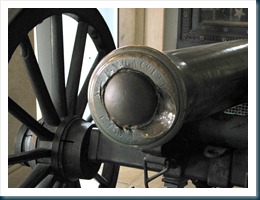
CannonThere is always so much to see and each state house we’ve visited boasts its own unique architectural detail or artifact or snippet of history; Rhode Island’s state house boasts a cannon used at the Battle of Gettysburg with a cannonball firmly embedded in its barrel, proving some Reb was a mighty fine shot.  The barrel and the ball were both so hot that they are permanently fused together.

While in Providence we visited a National Historic Site devoted to the story of Roger Williams and the founding of Rhode Island.  The city of Providence is a bit on the run-down side and we were happy to get away and head back to the campground to enjoy happy hour with our new-found friends, John and Barbara and their two Siamese cats.  It was very impressive to see the male cat, Chauncey, strolling along on a leash just as a dog might.  Having once had a Siamese cat as a pet, we know that such signs of cooperation are rare or perhaps our cat was just a contrarian. 

It rained mightily on the day we moved north to Naples, Maine but once we got around Boston the skies cleared and we had more or less pleasant weather for our entire visit to the Lakes Region of Maine.  Naples turned out to be a cute little resort community perched between Long Lake and Sebago Lake.  One visit to the local library and we were hooked.  It’s a big white house with a wrap-around porch, a view of Long Lake and hanging baskets of bright pink petunias dangling from the porch rafters.   And they have, by far, the finest used book sale section we’ve seen.  It’s an entire room in the basement, the books shelved just as they would be in any self-respecting library.  Their half-price sale was coming up the very next day so instead of cleaning house we went back to town to buy books. 

AugustaThe Maine State Museum is closed on Mondays so we made a special trip to Augusta on Sunday to tour the museum and then went back again on Monday to tour the capitol building.  Our tour guide was quick to point out that we shouldn’t expect to see any gilt, stained glass or other “just for show” adornment on the state house, Maine folks being frugal souls.  The Maine state animal is the moose.  There are signs along the highways and byways to keep alert for them but, once again, they eluded us.  Just as in Alaska, there were signs indicating their presence but nary a moose to be seen anywhere.  We are now convinced we are more likely to see a unicorn than a moose. 

Last year we were in Canada during the Fourth of July holiday and so weren’t able to partake of one of our favorite traditions, taking in a small town parade.  Naples ParadeBut this year we had Naples, Maine to enjoy.  It was a boiling hot day but we managed to set up our chairs in some semi-shade and settled in for the festivities, chitty-chatting with some of the locals and waiting for the excitement to begin.  All of the nearby towns sent their gleaming fire trucks, a local campground had a float, there were several Farmall tractors and just like that the parade was over with, the crowd cleared and we all went home to wait for nightfall so we could watch the fireworks out over the lake.  A rather severe thunderstorm moved in early in the evening, we lost electrical power and we decided to skip the fireworks, the pyrotechnics of the storm being sufficient.

Our next stop was Northwood, New Hampshire from which we made a drive to Exeter to visit the American Independence Museum, headquartered in the circa 1721 Ladd-Gilman House.  The Folsom Tavern has recently been moved to the same property and is now part of the tour.  George Washington may not have actually slept there but he did stop by for a visit in 1789.  Exeter is also home to the Phillips Academy, a prep school for the veddy veddy well-to-do. 

John and Barbara had invited us to camp in their yard during our visit to New Hampshire so we cancelled our reservations near Concord and went instead to their hillside home near Wolfeboro.  Wolfeboro bills itself as the nation’s first summer resort, perched as it is on the shores of Lake Winnipesaukee.  The town was hosting their annual arts and crafts fair plus Mitt and Anne Romney, local residents, were taking a break from campaigning so the town was teeming with tourists as we crept through our way through on the way up the hill.  Once we got settled in, John and Barbara whisked us off for a boat ride.  It was a beautiful bright afternoon and we enjoyed seeing all the interesting lakeside homes, some quite plain and ordinary, others fanciful and elegant.  Generally speaking, I’m not a big fan of boats but it was a most enjoyable afternoon.  Our entire visit was a pleasant change of pace, with happy hours and communal meals. 

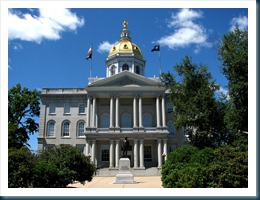
Of course we had to make the trek to Concord to visit the state house and get our passport stamped. NH Capitol It was a long drive over hill and dale but we didn’t have any time constraints and we arrived in plenty of time to take a leisurely stroll through the capitol building.  They don’t have tour guides but the lady in the gift shop stamped our book and sent us on our way to poke about at will.   New Hampshirites cannot complain about a lack of representation – the state has 400 members in their House of Representatives which works out to one representative per 3000 people.  Their chamber is arranged like an amphitheater with row upon row of seats but no desks.NH Legislature  They get paid $100 a year plus mileage and are expected to get their legislative work done in 45 days and go back to the real world.  On the other hand, there are only 24 state senators, or one per 60,000 people.  The state’s motto, which intrigues me, is “Live free or die and is attributed to a Revolutionary War general, John Stark.  Bought the tee shirt.  An enormous statue of Daniel Webster graces the front lawn of the state house.
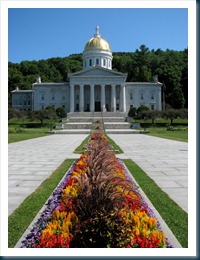
MontpelierAfter saying good-bye to John and Barbara and negotiating our way backwards out of their driveway the next stop on our New England tour was Williamstown, Vermont just a few miles southeast of the capital city of Montpelier.  Given that Vermont is such a small state and not heavily populated, it’s hard to understand why Montpelier is so very congested.  Everybody in the state, including children and pets,  must drive around alone in their cars all day.  We plunked a fistful of quarters into a parking meter and headed up the several flights of stairs to the massive pine doors.  Painted on the outside to look like bronze and inside to look like mahogany, they lead directly to the welcoming committee, a group of tour guides waiting to show off their state’s capitol.   Fire consumed an earlier version of the capitol and so when it was rebuilt it was made as fire-proof as the technology of the day allowed.  Which means cast-iron abounds – stair risers, radiator covers, supporting columns.  A statue of Ethan Allen guards the front door and the Goddess of Agriculture tops the golden dome.  The legislative chambers are beautifully restored to their original condition….or as close to original as old photos and building plans would allow. 

I was disappointed that the drive to The Vermont Country Store was in excess of 80 miles so we decided instead to make the much shorter drive to visit Rock of Ages Granite Quarry near Barre.  QuarryA tour guide accompanied us on the bus ride up to the quarry and provided a wealth of astounding facts regarding the granite memorial business.  Just the sheer weight of granite is mind-boggling…166 pounds per cubic foot.  Extrapolate that to the size of the blocks being lifted from the quarry and one is instantly awed by the strength of the derricks doing the lifting.  And how close to impossible it must have been back in the days when they used horses to drag the slabs out.  The days of blasting with dynamite are gone, along with the huge percentage of waste material.  Quarrying doesn’t look high-tech but it is.  Artisans turn the stone into beautiful and lasting memorials but also into machine parts both large and small.  We saw some enormous cylinders which are used to extract the water from wood pulp in order to make newsprint.

Libby DamRock of Ages has been in operation since 1905 when it was formed as the Boutwell, Milne & Varnum Company, and they’ve used just 1% of their total supply of granite.  According to the guide, they have enough left for another 4000 years.  During a tour of the gift shop/museum I came across a bas relief of some of the artwork which was installed at the Libby Dam in Montana in the 1970s.  Rock of Ages also provided many of the granite tributes at the WWII Memorial in Washington, D.C.  And of course the Vermont State House is made from Barre granite.  We were told that a majority of the quarrymen came from Scotland, near Aberdeen, and they settled in the highlands above Barre.  The stone carvers came primarily from the Carrera region of Italy and they choose to live in Barre in the valley.  Our guide urged us to visit Hope Cemetery where many of them are buried, their graves graced with tombstones of their own handiwork.

With the afternoon fading fast, we headed northeast to the small town of Cabot for a tour of the Cabot Creamery.  Owned by a consortium of dairy farmers, the factory has been in operation since 1919 and has won many prizes for their fine cheddars.  There was a lot of elbowing and jockeying for position around a counter spread with samples of many of the flavored cheeses Cabot produces.  The habanero cheddar cleared my sinuses quick as a wink…it’s not a subtle cheese.  They were all delicious, as were the dips and butter.  Our guide told us that it takes ten pounds of milk to make one pound of cheese.  We saw curds and whey being stirred in an enormous long vat, the whey eventually draining away (a-whey) and leaving the curds to be pressed into blocks.  The guide pointed out that New Englanders prefer white cheddar, the natural color, but that Cabot had trouble selling it “outside” where folks were used to yellow cheddar.  Sales picked right up when they began adding an organic color to the cheese. 

Unique MonumentIt was hotter than blue blazes (and humid to boot) when we visited the Hope Cemetery on Saturday.  One can hardly imagine the array of monuments!  There are some that were selected straight from the catalog but most are unique, lasting tributes to the skill and imagination of the carvers.  Some are austere, some elegant, some ostentatious with some whimsical themes thrown in for good measure.


We are now returning to New York, in the Hudson Valley where we will make sorties to visit the Connecticut capitol in Hartford and New York’s state house in Albany.  That will  leave just Hawaii’s page in the passport unstamped.  Maybe when they finish the bridge….

Sunday, June 10, 2012

Bouncing Around Kentucky, West Virginia and Ohio - 2012

Before it slips my mind again, let me introduce you to our new GPS.  She’s been with us for almost six months now and we’re getting used to each other.  Like her predecessor, her name is Nuvi because we are decidedly unoriginal when it comes to naming inanimate objects.  Unlike her predecessor, an American male who tended to get hysterical if you didn’t do exactly what he told you to do (and then pouted if you ignored him more than twice), this business-like woman issues her instructions in a stern voice and recovers very quickly with the next option if you didn’t follow instructions the first time.  She seems to know when you’ve deliberately ignored her or when you’ve simply over-shot a turn and issues her next directive accordingly.  She does not recalculate, she adjusts.  Smart woman.  However, she does share her predecessor’s slight dyslexia…what she tells you is up here ahead on the right is very often up here ahead on the left.  And vice versa.  Nuvi I had trouble pronouncing Walmart, rolling the “wal” around in his mouth like a wad of chewing gum; Nuvi II cannot pronounce “supercenter”(it comes out sue-purse’-in-ter) but we love her just the same.

Patton Museum

So with Nuvi II’s assistance, we located our campground in Glendale, Kentucky and made forays from there northward to Fort Knox to visit the General Patton Museum.  The museum is in a state of transition, with the Armor School and its remaining armor units -- the 194th Armored Brigade and the 316th Cavalry Brigade, having been moved to Fort Benning, Georgia and replaced with a museum devoted to the subject of leadership.  We did see replicas of Patton’s pearl-handled revolvers, his reconstructed staff car and various bits and pieces of military attire.  Gold DepositoryThere’s a sizeable auditorium where a constant loop of the George C. Scott movie, Patton, is played.  Not far from the museum, the highway passes within a short distance of the National Gold Depository where the nation’s supply of bullion is stored.  Tours are not allowed, not that there’s anything left in there anyhow, but we were able to pull off the road and take this photo.  Altogether, this was not an exciting trip and we were soon on our way back to Glendale.

At the visitors center in Elizabethtown (called E-town by the locals) we picked up a Swopes Museumbrochure for the Swope’s  Cars of Yesteryear Museum and we’re so happy we did.  It’s a little treasure.  The museum sits amid several Swopes owned and operated car dealerships and is open to the public with no admission fee.  The cars are beautifully restored, although not all to original standards.  The gorgeous saddle tan and burgundy roadster probably was available in basic black when it was brand new.  One of my favorites was a ‘56 T-bird in  a desert coral color.   There was also a Nash Metropolitan – remember them? – which looks downright roomy and comfortable compared with some of the sub-compacts of today.  Not to mention a little more stylish.

Lincoln Birthplace

The next day we took a scenic byway to visit the Abraham Lincoln Birthplace NHP near Hodgenville at the site of Sinking Spring Farm once owned by Thomas and Nancy Lincoln, Abraham’s parents.  The memorial surrounds the log cabin where Lincoln was born and is reached by 57 steps, one for each year of his life.  Unfortunately the farm was lost in a land dispute and the Lincolns moved to Knob Creek Lincoln Knob Creek Homewhere Abe spent his boyhood.  It’s hard to imagine a family of four living in the small square cabin which has only one window and one door. A knob, by the way, is what they call hills around this part of Kentucky.   The scenic byway led us eventually to Bardstown with its historic downtown.


Bourbon Museum


Naturally we had to pay a visit to the Oscar Getz Museum of Whiskey History and the Bardstown Historical Museum.  The whiskey museum told us more than we needed to know about bourbon.  We were told there’s a building in town with a cannonball imbedded in a wall, a scar from Civil War days, but we weren’t able to locate it on a quick drive-by and with serious storm-clouds gathering we opted to forego history and head back to the coach before the skies opened up.

Our final night in Glendale was on the soggy side with a heavy rain that lasted most of the night but at least the tornado warnings remained much further north of us.  It was still dripping the next day as we pulled out for the drive to Huntington, West Virginia.  We encountered fairly heavy rains around Lexington but by the time we reached our campground, it was merely overcast.  We’ve often stayed at campgrounds that are “multi-purpose” but never one that was both an RV park and Skydiveran airfield.  Air activity was up and running by 9:00 the next morning with someone practicing touch-and-goes on the grass strip behind our coach.  We were gone most of the day so it didn’t bother us in the least and by the time we got back late afternoon the skydivers were making their last jump of the day.  The group we saw was very accurate, landing on their feet within a few yards of the clubhouse.  Good thing, too, because just beyond the hedgerow is the Ohio River. 

National Radio Museum

While others were jumping out of planes, we were in downtown Huntington visiting the Museum of Radio & Technology, another freebie, crammed chock-a-block with old radios, phonographs, shortwaves, computers and television sets with round screens.  When faced with those monster radios with their knobs and dials, fabric-covered speakers and wooden cases one cannot help but hear the ghostly voices of their favorite radio shows from childhood.  Why did we always sit on the floor and stare at the radio?  Were we just practicing for the days when television would come along and knock the radio off its entertainment pedestal?

J Taylor CollectionOur next stop was the J. Taylor Auto Collection, generously displayed to the public at no charge by the proud owner.  This 1930 Cadillac limousine was reported to be air conditioned.  I’m not sure how well it worked but there was a tiny fan affixed to the steering column, pointing straight at the driver’s face.  With its V-16 engine, the car probably could have reached sufficient speed to keep things cool inside, even without the little fan.  This was another stellar array of impressive old cars, including the ‘64 Impala one of the docents drives back and forth to work each day. 

Cambridge Glass MuseumRarely do we travel on Sundays but we’re on a condensed schedule so we traveled through the hills and hollows of West Virginia, enjoying the sunny skies and pretty scenery.  We arrived in Cambridge, Ohio shortly after noon and got hooked up before dashing off to town in search of a Sunday newspaper.  And aren’t we glad we did!  Howie noticed a sign for a museum and we followed the arrows to the National Museum of Cambridge Glass.  We arrived with an hour to spare and the hostess volunteered to stay late if we didn’t finish our tour by closing time.  The Cambridge Glass Company opened in 1902 and continued operation until 1958.  The museum is maintained by the members of an organization devoted to the collection of Cambridge glassware.  Beautifully displayed and lit in sparkling glass cases, the array of shapes and colors was dazzling.  The blues, reds and greens were particularly rich and vibrant.  It wasn’t so much a downturn in the economy that put Cambridge Glass out of business but a trend toward…yuk…plastic, cheaper products from the Orient and a lack of interest on the part of the American housewife in tending to large collections of stemware.

With only two days in town, we made haste on Monday morning to visit downtown Cambridge.  Signs led us to Mosser Glass, founded by a former employee of Cambridge Glass.  We were shown through the factory to watch pressed glass pieces being made.  It’s a  fascinating  process which has probably not changed much over the ages.  The guide told us that machines sometimes do the pressing but in the case of Mosser the glassmaker pulls the heavy lever to compress the molten glass into the mold.   With an abbreviated range of colors and patterns, Mosser continues to survive in a niche market.  They also have a second factory which makes glass products for the pharmaceutical trade…beakers, funnels and such.

Our final stop in Cambridge was The Hopalong Cassidy Museum and Antique Store.  The museum was free, thank heavens.  It would be difficult to decide how much that experience might be worth in terms of admission fee.  I did see a photograph of Guy Madison, just like the one I had as a pre-teen.  If only I’d had the foresight to save all that clutter.

Thursday, May 31, 2012

Whirlwind Tour–Oklahoma, Arkansas, Kentucky–Spring 2012

Given the severe tornadic activity in the past few years, we were just a little jumpy at the idea of crossing Tornado Alley so we put our heads down, pointed the coach due east and got across the plains as quickly as leisurely touring would allow.  Route 66 MuseumExcept that we kept inadvertently using the Interstate to just to get around town, our stay in Clinton, Oklahoma was uneventful.  Clinton is home to the Oklahoma Route 66 Museum (the National Route 66 Museum is back up the road in Elk City) and we were fortunate enough to pay a visit on a lazy Sunday afternoon when admission fees were being discounted.  The museum is a little short on artifacts but long on story boards and blow-ups of photos from the heyday of The Mother Road.  The parking lot was filled with motorcycles, all ridden by folks speaking a foreign language; German, perhaps, or Dutch.  We surmise they were doing a grand tour of the historic road, living out their Jack Kerouac fantasies.  Our visit to this museum reminded us we should make a point of watching “ The Grapes of Wrath” the next time it’s on TCM.

Only rarely do we do one-nighters but decided to stop in Checotah, Oklahoma for just a little shut-eye before leaping into Arkansas heading to Conway. We took comfort in the fact that our site was within an easy dash to the tornado shelter, a half round metal thing with murals painted on the side.  It didn’t look all that substantial.

This was our second visit to Conway, a sizeable city which describes itself as being between Toad Suck and Pickles Gap.  And it is.  We had reservations at the Corps of Engineers campground at Toad Suck Ferry, a pleasant spot on the river.  The riverfront site we were assigned was nowhere near level and so we opted to move inland.  The park is used heavily by Conway school children on outings and so most mornings we were greeted by noisy groups of kiddies at play.  Fishing is also very big in this neighborhood and many of our neighbors were towing boats, not cars. 

While we were still in Amarillo we began to notice big ol’ moths zooming through the coach at night, bumping into things and making pests of themselves.  It was learned that they are called millers and that this was a big year in their cycle.  We were still pursuing them all across Arkansas and may finally be rid of them.  They can leave a welt if they hit you head on.

Except for the cocktail lounge at the Peabody Hotel, there is not much I like about Memphis, so it was no hardship to just stay on the Arkansas side of the river in West Memphis, get some chores done, do a bit of grocery shopping and hunker down to wait out a terrific downpour.   Mississippi River         We were camped at Tom Sawyer, a campground which is smack on the Mississippi River and could see (and hear) the tugs moving the barges up and down the river.  The big diesel engines are felt more than heard and quite often the thrumming was enough to wake a body from a sound sleep.  This location is almost enough to make a person want to re-read Mark Twain.

The storm passed during the night and we had only overcast skies left for our drive to Paducah, Kentucky.  Given my aversion to bridges, it came as a rude shock that I’d plotted our course to take us over not one but two two-lane bridges, the first across the Mississippi and moments later one across the Ohio.  These are not shiny new bridges.  The lanes seem barely wide enough for cars to pass safely going in opposite directions so it was nerve-wracking to meet a procession of on-coming semis.  It seemed like a minor miracle that we didn’t clip any mirrors.

The main reason we headed to Paducah was to get off the road for Memorial Day.  We’ve visited the city before and had toured most of the major attractions.  The owner of the campground supplied us with so much information about what to see and do that we really didn’t need to go to the Welcome Center at all.  But we did because it is housed in a really gorgeous 1860s mansion.

Whitehaven

The campground also provided us with free passes to the William Clark Market House Museum; we had toured the museum on our first visit to Paducah and without those passes probably wouldn’t have gone back for a second look.  And we would have missed out on a wonderful afternoon.  We were the only customers and the curator was able to spend time with us, pointing out various treasures and feeding us snippets of history.  

Following a devastating flood, a wall was constructed to keep the Ohio River from reaching the historic old downtown area.  When confronted with an ugly gray wall, what’s an artistic community to do but decorate the whole shebang with a collection of murals depicting the city’s various claims to fame.  MuralsThis is the least threatening riverfront you can imagine; it’s proximity to the National Quilt Museum means there’s plenty of grandfatherly fellas wandering around, waiting for their wives to finish touring all the fabric shops that have mushroomed up around the museum.  Most of these men are loaded down like pack mules with bags of notions, pattern books and, of course, yards and yards of fabric.  They look bemused.  And bored.

During our conversation with the curator at the Market House museum we were struck with how much her narrative and personal touch went into making everything come alive.  When we told her we were fans of small-town museums, she urged us to visit Adsmore, located in Princeton, Kentucky. 

Adsmore

So the very next day we got an early (for us) start and headed up the highway toward Princeton, a forty mile drive.  Adsmore was built in 1857 by a local merchant.  But he fell upon hard times and sold the house in 1900 to John and Nancy Smith and their daughter and son-in-law, Robert and Mayme Garrett and their new-born daughter Katharine Garrett.  Ms. Garrett never married and when she died in 1984 the town was surprised to learn she had willed the house and all its contents to the Caldwell County Library District.  Fortunately she also left a sockful of money to refurbish the house and to keep it open as  museum.  This place is an absolute treasure!  Those in charge have found a unique way to show off the enormous stash of furniture, clothing, linens, silver – they stage tableaus where the house is decorated with trappings from whichever event is being highlighted.  We were lucky enough to arrive in time for Selina Smith’s (Mayme’s younger sister) wedding to John Osborne.  The parlor was decorated with wedding flowers, the minister’s Bible and reading glasses were on a table by the mantle and the photographer’s camera was at the ready.  The wedding gifts were on display, along with a mannequin wearing Selena’s beautifully preserved wedding dress.

We’ve toured quite a few historic homes and I don’t recall ever seeing one which showed so little wear and tear.  I was amazed at how fresh and pretty all the linens looked.  I saw only one bed skirt which showed signs of age, having yellowed in spots, and the mother-of-the bride’s dress was clearly in distress.  But everything else, including the most delicate laces, were in wonderful condition.  The table was set for a formal buffet (for 100 guests) and the cut-work cloth and napkins were pristine.  It was probably Katherine who took the time and trouble to preserve everything so well.

The most interesting part of the Adsmore story, however, was Selina’s choice of a groom.  She met John Osborne while they were both touring in Egypt.  He was considerably older, a doctor and the third governor of Wyoming.  Do you remember a baddie from Wyoming’s early history, “Big Nose George” Parrott?  You’ve met him earlier in these pages.  His is a fascinating story and Dr. Osborne was one of the physicians who tried to figure out what soured George on the good life…and who wore shoes made from George’s hide to the ball when Osborne was inaugurated as Governor of Wyoming.  So here’s Selina, a wealthy popular Southern beauty, being married off to a wild-and-wooly Westerner. 

Photographs are not allowed in the house and the website is not overly informative so you’ll have to use your imagination to picture one of the photos on display in the house….it’s a photograph taken in front of the pyramids in Egypt, Selina and her sister Kate and Kate’s husband James are sitting on camels, dressed to the nines in what appears to be heavy winter clothing.  Kate and Jim were supposed to be chaperoning Selina on this trip but apparently weren’t doing a very good job of it.  Because right beside Selina, astride his own camel, sits Dr. Osborne.  The ladies were wearing those enormous wide-brimmed hats, all covered with flowers, looking ever so chic.  The gents had on top hats.  The camels wore goofy grins as camels always do.

So Adsmore gets a big A Plus Plus from us as a must-see if you find yourself in that part of Kentucky known as The Land Between The Lakes…Princeton isn’t between the lakes but it’s very close.

We have one more stop in Kentucky,then it’s on to West Virginia.  Stayed tuned.