Monday, July 11, 2016

On The Road….Again

It was approaching time to begin planning a road trip to escape Phoenix’ blazing summer heat but the heat arrived sooner than expected and not much in the way of planning had been done.  There was a vague idea of heading toward Oregon to spend time on the coast with faux family Ruthee and Gail but then Ruthee got scheduled for foot surgery and would be recuperating right smack in the middle of the best time to be on the Oregon coast.  That’s a long way to go to not be able to do what you wanted to do so we modified plans to include a giant circle which would take us to Grand Teton and then back to some of our favorite haunts along the way.

An arbitrary date was selected for departure.  The weather forecast was for temperatures to be slightly over 115o F at the time we’d be loading up the coach and we just couldn’t face the prospect so we postponed departure by a week.  Temperatures never did moderate much but we had to bite the bullet and start the chore.  There was even less rhyme or reason to our packing process this time and, as we’ve since learned, many useful items were left behind. 

Bug Creek FireOur first stop, as has become habit, was to be Camp Verde.  Shortly after passing through Black Canyon City, not an hour from home, Howie noticed a plume of smoke ahead of us and it wasn’t long before traffic on I-17 slowed to a crawl and then stopped completely.  We could see planes and choppers dropping water and fire retardant not far off in the distance.  There we sat in 107o heat, bumper to bumper, for three hours.  We were more fortunate than most, being able to run the generator to keep the a/c and refrigerator operational, with convenient access to cold water and a bathroom of our very own.  The CB radio kept us informed as to progress or lack thereof of the fire crews ahead of us.  The southbound lane reopened in pretty short order but we northbound folks seemed to be stuck in place.  There are stretches along I-17 where exits are few and far between and even where there are exits, there’s nowhere to go once you get off – just some dirt roads wandering off into the desert, no services, no nothing.  By late afternoon we had inched our way to one such exit and there was nothing to do but to exit and get back on southbound and find a campground for the night.

And so we did, arriving in Anthem in time to cook supper, watch a little (very little) t.v. and hit the hay for an early start the next day if the highway had been reopened northbound.  And it was.  As we drove past the exit we had used, we could see that the fire had burned right up to the edge of the highway and traffic was confined to one lane as work crews replaced the guard rail posts which had burned in the fire.  But the fire was out, no homes were lost and many travelers were inconvenienced but not harmed.

Camp Verde was at least ten degrees cooler than The West Valley and the nights considerably cooler but it was still a little too warm to turn off the a/c and open all the windows.  One of the plans on our agenda was to meet friend Pat for a trip to the Pine Strawberry Arts and Crafts Festival.  I had a notion that the festival had something to do with strawberries.  Nope.  Pine and Strawberry are two small towns up in the mountains on the road to Payson.  It had always been an intention to visit Payson.  Okay, you can check that off the list.  Yes, it’s pretty and yes it’s cooler but there’s only one road in and one road out and the tinder-dry pine forests seem dangerously close.

Another day was spent poking around in Prescott and Prescott Valley.  We visited a number of RV parks with an eye to perhaps booking ourselves in for a few months next summer.  But nothing struck our fancies in particular and we more or less shelved that idea.

With the 4th of July upon us, Pat had invited us to her place to watch the fireworks from her back patio.  We had an not-so-old fashioned picnic dinner.  Her house is on a hill over-looking the Fairgrounds so we had a fine view of the fireworks.  But they were overshadowed by an enormous black sky filled with stars and we realized once again how nice it is to get away from big city lights.

One of the reasons for making Camp Verde our first stop is to be close enough to home to run back for any really important things which might have been left behind.  We had our meds and eye glasses with us but did have to shop for things like nail clippers and assorted other small items.

After doing a rather thorough job of checking out the antique stores and thrift shops (and acquiring a few small treasurers) in the area, we moved on north and eastward, spending several days in Grants, New Mexico, a place we’ve not stopped in the past.  Grants is one of those small cities along Old Route 66 that slowly faded away when I-40 came into being and traffic kept on moving.  The cluster of chain motels at the highway’s exit seem busy enough but there are plenty of vacant buildings along what once was the Mother Road that still serves as the town’s “main drag”.  We had hoped to visit the Acoma Pueblo, known as the Sky City, but their brochure indicated that it would be closed for an extended period of time, including our time in the neighborhood.  And, yes, Grants is plural because it was founded by three brothers named Grant; had there been only one brother we’d be spending time in Grant.

NM Mining MuseumWe had about given up hope of having something interesting to do during our visit in Grants so we had rather low expectations when we wandered into the New Mexico Mining Museum and stumbled into another one of those magical circumstances that make RVing so much fun.  A gentleman at the front desk offered to be our tour guide and we always say yes to those offers.  We quickly learned that what was once mined in this part of New Mexico was uranium and that there were once 25 mines operating between Gallup and Albuquerque and that we had as our guide someone who had worked in those mines for an extended period of time.  Using a real uranium mine for display purposes would be hazardous so a condensed but very realistic (this assessment was re-enforced the next day by a real life geologist) replica has been recreated in the basement of the museum.  By realistic I mean that there were pieces of actual (and well-used) equipment lying about, Ore Carssandstone dust and chucks of stone on the floors.  Nothing looked the least bit new or clean and we had Mr. Jack Farley to give us a blow-by-blow description of life in a uranium mine.  His love of the topic was obvious and he made us feel a small part of the experience.  The mines are all closed now because it’s cheaper to buy uranium from other countries than to mine it here.  These mines once employed 7500 people; nowadays you’d probably have trouble finding a half dozen willing to do that hard and dangerous work at any price.

When we got back to the surface, which also serves as the Chamber of Commerce, Mr. Farley pointed out a small display of rocks and other items of interest which were displayed in tidy glass cases around the room.  An item of special interest was a dinosaur bone, the interior of which contained iron pyrite (fool’s gold) crystals which Jack had unearthed 800’ below ground in one of the area’s mines. 

El Malpais National Historic Monument is located not far from Grants so we took off on Saturday morning to do a bit of exploring.  It turns out that El Malpais (which means “the badlands” in Spanish) is a park best explored on foot…if you are young enough and strong enough to tackle it.  La Ventana ArchWe watched the brief film and headed down NM 177 which runs along the east side of the park, stopping again at the BLM ranger station for further advice on what to see and how to get there.  It turned out that the 1 1/2 mile long access road to the Sandstone Cliffs overlook is not paved.  While it is a pretty decent road, it was just not comfortable in the Saturn so we turned around and headed back toward pavement.  Progressing further south, we came upon La Ventana Natural Arch which had the good sense to place itself near the highway.  By then it was noon and we had no inclination whatsoever to hike even the shortest distance to see it.

El Malpais NHMThere were beautiful sandstone formations, sculpted by eons of wind and rain, some free-standing, others clinging to cliffs and hills.  And there were plenty of lava flows from the ancient volcanoes that dot the area.  This park is one best explored in a more moderate season and with much younger knees.

On the way home we stopped at the Route 66 Vintage Museum located in the Double Six Gallery.  The museum tells the story of Route 66 in and around Grants through a selection of enlarged postcards which show Grants during the heyday of The Mother Road.  Most of the Route 66 Vintagebuildings pictured still exist, although not now serving their original purpose….or any purpose at all for that matter.  The docent volunteered the information that carrots had once been a huge cash crop in the area, something we never would have guessed, this being a high desert area.  Uranium and carrots, what an interesting combination. 

And now it’s onward and upward towards Santa Fe….stay tuned.

Friday, October 23, 2015

Life Is What Happens While You’re Making Other Plans

In case you haven’t noticed, quite a few months have passed since our last posting.  We were so busy “coping” that there hasn’t much time or energy left over for composing.  The RV presented us with a number of issues that needed immediate resolution.  In addition, there were  a number of non-coach-related problems that also demanded prompt attention.

Our last posting found us somewhere in the south-central U.S., decrying the heat and humidity every step of the way.  To add salt to the wound, the washer/dryer combo in the coach developed a tic (or maybe it was a tick).  The dial kept going round and round with no obvious relationship to what cycle was happening inside the device.  A phone diagnosis was made by the distributor and a part shipped to our destination in Louisiana.  Meanwhile we’d just wait ‘til we ran out of underwear and then hit a laundromat.  We made brief stops in Mt. Vernon, Illinois and Caruthersburg, Missouri and in Kensett, Arkansas which was the site of a Civil War battle known as The Battle of Whitney’s Lane by the South and The Skirmish of Whitney’s Lane by the North.  Either the North underplayed it because they lost or the South overplayed it because they won.  In either case, the Texas troops that came to the South’s rescue later evolved into the Texas Rangers.  Or so the story goes.

Much earlier in our journey, the shower door had fallen off and had to be repaired.  Remember that?  Well, then the refrigerator door fell off at 6:30 one morning.  Fortunately it did not require much in the way of repair.  And then Howie had to rebuild the shore power plug in 100 degree heat and what must have been 99.9% humidity.  And, of course, the a/c couldn’t function until the repair was made.

While we were at a Corps of Engineers park on the banks of the Arkansas River, we made the mistake of taking the advice of a total stranger regarding a “fine dining experience” in Star City.  Not only did the GPS take us cross-lots on dirt (and mud) roads but when we finally arrived the food was hugely expensive and lousy.  Both our meals arrived stone cold and the waiter had an attitude when we sent it back for re-heating.  Usually restaurants give you too much food.  Not this place.  We had itty-bitty pieces of steamed grouper topped with a heaping tablespoon of shrimp etouffee.   We both foraged for snacks when we got back to the coach. 

On our final day on the banks of the Arkansas, some severe weather was approaching so we hustled to get on the road ahead of it.  We made the longish jaunt to Monroe, Louisiana in good order and eventually got settled in.  If you ever find yourselves in Monroe with some time to kill, head on over to the Visitor and Convention Bureau and have a chat with Dorothy.  Duck CommanderShe’s a delight, y’all, and very helpful.  We were only vaguely aware of the Duck Commander phenomena and definitely didn’t realize we were at the epicenter of all the fuss.  So Dorothy pointed us in the direction of DC Headquarters where I acquired a copy of Miss Kay’s cookbook.  I was disappointed the book did not contain the recipe for banana pudding with caramel that I’d been hoping for.  But it wasn’t long before I found a cookbook which does.

Tall Skinny HouseFor some reason I had really high hopes for Alexandria, Louisiana but it turned out to be a rather depressed and depressing city.  A military base closure caused a severe down-turn in the economy and the town fathers have not yet figured a way to replace it and get things humming again.  After just one day we were eager to hit the road for Lafayette for an extended visit with fellow RVers, Rose and John.  We indulged in some serious antiquing, drove through swamps and spotted this tall skinny house with some less-than-welcoming signage, and feasted on Rose’s Cajun cooking.  While John and Howie tackled some RV repairs, Rose and I sat around drinking coffee and solving most of the world’s problems.  The solution we came up with was to say screw it and have another glass of wine.

We left Lafayette just in time to avoid moving up a full dress size and made a stop in Beaumont, Texas to prepare ourselves for another few days of boondocking.  Not only did we discover that repairs to the washer/dryer didn’t work but the lock on the coach’s one and only door was broken beyond simple repair.  It’s just a good thing one of us was still in the coach when it happened, otherwise there’d have been some breaking-and-entering going on.  That’s the bad news.  The good news was that there was an RV tech available immediately.  But then the bad news was that he didn’t have the necessary part to repair the lock.  The good news is it was available from the factory and it could be overnighted to us for installation the very next day.  So now we have a new door lock, the cost of which would make the Pentagon proud.  And UPS got most of it.

Remember back to the incident in Rapid City when our cell phone number was hijacked by some unknown creep but Verizon was able to retrieve the number and put it back on our industrial strength flip phone.  We were in Beaumont when those chickens came home to roost.  Verizon had so totally screwed up our bills and payments and were threatening to shut off our phone service if we didn’t pay up immediately if not sooner.  They were even threatening to shut off a phone we didn’t have.  This all came to a head while we were sitting on the shores of Lake Conroe on a campsite that had only a nodding acquaintance with “level” and enjoying some good ol’ Texas humidity.

And for a Labor Day gift we got the good news that a neighbor back in Geezer Gulch had spotted water coming out from under our garage door and had shut off the water to the house.  Bless his heart.  His quick action and notification of The Posse saved us from a true disaster.  Oh, yes, there was some damage done and some items were lost to water damage but it was nowhere near as bad as it might have been.  We overnighted a key to our former neighbor and there was a clean-up crew in the house the very same afternoon.  Everything was so under control that we were able to continue our trip in the knowledge that things weren’t going to get any worse. 

HummingbirdNext on our itinerary was a stop in Beeville, Texas.  A seriously inattentive clerk at a fuel station handed Howie’s credit card to someone else and then denied doing it.  We had to drop everything and make a quick call to the bank to cancel the credit card and make arrangements for new ones.  The good news was we’d be in one spot long enough to get new cards sent immediately.  It’s hardly worth mentioning that a big rock leapt out of the landscaping and gouged a rear tire – that make and model tire will not have replacements available until the end of the year.  After all the stress and strain of the past few weeks, it was a delight to join Jack and Sally on their ark for some peaceful country living.  They have two dogs, two donkeys and a yard full of birds – green jays, Altamira orioles, cardinals, swarms (I do not exaggerate) of hummingbirds and a family of roadrunners.

Mac's BBQWhile there we made a pilgrimage to Goliad to check out Market Days, then off to McMillan’s BBQ for a selection of brisket, ribs and sausage.  Sally had filled the back of the truck with potted plants so we drove for miles and miles surrounded by foliage and the tantalizing smell of Texas BBQ.  Suffice it to say we fell upon it as soon as we walked in the door.

We had the scuffed tire checked by an expert in San Antonio who pronounced it okay and we we continued on to Kerrville for a visit with former full-timers Bill and Jeanne.  RVers are so easy to get along with.  Faust HotelThey are pretty much willing to try anything and are always on the look-out for new experiences.  The four of us trolled around Trade Days in Fredericksburg for hours until our feet were screaming and sweat was flowing.  Bill had a commitment to attend a Navy get-together so Jeanne joined us for a trek to Comfort and it’s art tour.  What a charming little town.  There are plenty of old stone houses, some converted to shops and the newly remodeled Faust Hotel.  I wish there’d been time to sit on the porch, drink a sweet tea and watch the world go by.  And to wrap up our visit we attended a wine tasting.  Only in Texas could you be drinking chardonnay and listening to old-timey country music.

Ordinarily we try to avoid crossing West Texas, which has to be one of the ugliest places on earth.  But by now we were in a hurry to get home and assess the water damage ourselves.  Rex Allen MuseumWe decided to drive a bit further each day and stay just two days at each stop.  Which is how we came to find ourselves in Fort Stockton (again), Las Cruces (again) and Willcox (again).  This time Willcox was having a birthday party for Marty Robbins at a museum devoted to the Arizona native.  We had some birthday cake, listened to some local singers and pickers.  On the same block is the Rex Allen Museum, Rex’s horse is buried across the street in a little park by the railroad tracks and Rex’s ashes are a-blowin’ in the wind around Willcox. 

It must be that West Texas and New Mexico enjoyed more of the monsoon season than normal so we were able to traverse through shades of green rather than shades of brown.  It helped to shorten the trip significantly.

When we arrived home in Geezer Gulch we checked in at a nearby RV resort and beat a hasty path to check out the damage done to our house by leaking plumbing.  It wasn’t anywhere near the disaster we were anticipating.  After coping with one mini-crisis after another all summer long, this was just one more situation to be dealt with.  Being back on solid ground seems a little sweeter this time.

Wednesday, August 12, 2015

Rallying And Other Such Activities

After driving up and out of the hole-in-the-ground campground, we headed east toward the Wisconsin Dells and our first RV rally of the season.  It wasn’t long before we were made aware of the fact that Wisconsin must purchase their roads, second-hand, from Minnesota.  We’d just barely crossed the Mississippi River when we hit a stretch of Interstate that shook, rattled and rolled us all the way to our campground in Lake Delton.  Rough roads seemed to be the norm all over the north central states and the states with the highest tax rates seemed to have to the worst roads. 

This was the first time we’ve attended a tri-chapter rally and the wagonmaster had selected a dandy campground for headquarters.  Unfortunately the weather was so hot and humid that we were warned to be careful using the air conditioners.  We could either run both air conditioners and run the refrigerator and water heater on propane or we could use one a/c and use shore power for the water heater and fridge.  So we “coped” as so often happens when you’re camping out.  Having only one air conditioner is our current benchmark for “roughing it”.  It still rankled, however, that we were paying for 50 amp service and wi-fi but getting neither. 

LumberjacksOne of the perks of the rally was a lumberjack show at Paul Bunyan’s Restaurant where we watched four strapping young men ply the skills of the timbermen who once populated this area of Wisconsin.  They chopped and sawed, climbed and leapt about in a frenzy of activity and their antics kept us laughing and gasping for breath on their behalf.  Most of the audience was of such an age that such vim and vigor was only a distant memory. 

While a number of attendees at the rally went off to view The Dells from boats of various sorts, we took the opportunity to make the run to Baraboo to visit the International Crane Foundation.  The Foundation was originally established by some Cornell University graduates to save the Whooping Crane from extinction.  Their display facility on Shady Lane has every species of crane on exhibit.  Away from the prying eyes of tourists, the Foundation continues to work hard to save the several species which are still endangered.  Blue CranesWe found the blue cranes to be almost ghostly in their appearance and the two species of crowned cranes absolutely regal with their golden spiked hair-dos.  The 120-acre facility has been seeded with wildflowers and native grasses and was a-bloom with flowers and a-buzz with bees.  The researchers at the Foundation have to do a great deal of manipulating in order to keep some of the species viable.  We were surprised to learn that cranes don’t reach breeding age until they are six or seven years old and can live on well into  their 60’s and 70’s.  However, a high percentage of the eggs laid are infertile and good parenting skills do not come naturally so there is a great deal of egg-swapping  involved in maintaining the population of several crane species.  And those pairs who exhibit good parenting skills are often called upon as surrogates for abandoned fledglings.  

Our next stop was Menominee Falls, a suburb of Milwaukee, where we visited with Cousin Judy and her husband Dave.  There being no affordable campgrounds available nearby, we spent two days (with permission, of course) in a church parking lot.  Judy and Dave squired us around to all the thrift stores and antique shops in a 50 mile radius and we acquired several new items of interest, not to mention a stack of irresistible books.  I find nearly all books irresistible, especially when they are in perfect condition and cost less than a dollar.  On our last evening in town, Judy and Dave took us to a restaurant ‘way out in the country.  The portions were so large that we had enough left-overs for two more evenings!  As we left the restaurant, Judy mentioned that we were close to Holy Hill which she wanted us to see.  Somehow, a wrong turn was made and we ended up laughing ourselves silly as we shot up hills and down dales in search of the illusive basilica which caps Holy Hill. 

It was necessary to have a full-service campground just prior to heading to the FMCA convention in Madison.  The tanks that should  be empty need to be empty and the tanks that should be full need to be full.  So we headed northward to the town of Two Rivers on Lake Michigan to a small campground with the necessary facilities but not much else in the way of amenities.  However, it  gave us an opportunity to visit our old friends, Harold and Ruthann, whom we met on our very first visit to Apache Junction some ten years ago.  Ruthann was slated to baby-sit for her great-grandbaby and so we headed off to see the sights on our own and returned in time for a pizza binge on Saturday night.  One of the most attractive spots we visited was the West of the Lake Gardens perched on the shores of Lake Michigan about midway between Two Rivers and Manitowoc.  This privately-funded garden is open to the public at no charge and was at the peak of its summer glory during our visit.  The allee of Queen Elizabeth roses looked and smelled delicious while off in the distance we caught a glimpse of the ferry, Badger, starting her cruise across the lake to a port in Michigan.  This wonderful garden is supported by funds provided by its founders, Ruth and John West, and it continues to flourish as a living memorial to their commitment to that neighborhood.              

West of the Lake Gardens

Joseph Vilas, Jr. HouseOn Sunday we hit a few antique shops in Manitowoc and wrapped up our visit with a stop at the Rahr West Art Museum.  Yes, the same Wests as the garden.  The Victorian style mansion was donated to the city of Manitowoc in 1941 for use as a museum and civic center.  In 1975 a modern wing was added to house the permanent collection with both permanent and rotating exhibits.  The mansion itself is open to the public and filled with art and artifacts, the upstairs rooms being given over to various collections, including the Simon Schwartz Chinese Ivories.  It was a pleasure to wander around the rooms of the mansion and inspect those displays which most interested us.             Simon Schwartz Chinese Ivories

Two Rivers Visitors CenterWe learned that Two Rivers lays claim to the invention of the ice cream sundae.  Unfortunately we got too busy doing other things and never got back to the visitors center to try the root beer float made with root beer ice cream.  They were dubbed sundaes because they were originally only served on Sundays – or so proclaimed the sign in the town square.


The weather had been borderline uncomfortable with heat and humidity and it only seemed to get worse as we made our way to Madison for the FMCA Family Reunion.  We learned our lesson some years back and sprang for the extra fee for an electrical hook-up.  Those big green generators may have been noisy but they did an excellent job of providing a steady supply of amperage, enough to keep one a/c going nearly constantly.  The convention was a flurry of meetings, happy hours, seminars and meeting and greeting friends and acquaintances we haven’t seen since the last convention.  It was so good to see folks again, especially those who’ve had serious illnesses recently and who have made wonderful recoveries.

By the end of the convention, all the tanks that should be full were empty and those that should be empty were full so we made our way back to the full-service campground in Lake Delton to remedy the situation and to attend another brief rally for the purpose of dumping holding tanks, doing laundry and resting.  We decided to extend our stay an extra day so we could make the 40 mile run to Spring Green for a visit to the House on the Rock.  Others who’ve visited have raved about the place and so we felt we’d be missing something if we by-passed it again.  To my mind, the admission fee would have been better spent elsewhere.  There was a lot of walking involved and by days’ end I was just about played out.  Many of the display cases were so poorly lit that we could barely see what they held, others weren’t labeled at all so we were left wondering what we were looking at.  And, in spite of the hefty admission fee, almost all of the animated musical displays required a token or two (four for a dollar) to activate them.  I  admit to being disappointed. 

We were advised to stop at a scenic overlook on the highway north of the House for a long-range look at the Infinity Room and the Rock after which the house was named.  It was another long trek on a hot and humid day.  The view was partially obscured by trees and by then I was singularly disinterested in the House on the Rock and anything connected to it.

Having barely rested from all that hiking, we hitched up the car and headed due south for a brief stop-over in Rockford, Illinois.  For as frenetic as the rallies had been, the campground on the banks of the Kishwaukee River was peaceful and serene.  Jackie and Roy were also stopped there, along with their friends Ramona and Gary, so we had a potluck feast Wednesday evening, featuring the trout that Jackie had caught on an outing at Two Rivers.  They went geocaching and we went antiquing and we all met again the second night for an instant replay of the previous potluck, this time with fish tacos. 

Our paths diverged on Thursday when we headed south to Bloomington/Normal and they headed east toward Fort Wayne.  The only reason we were stopping in Bloomington/Normal was so I could buy a t-shirt and/or coffee mug declaring we had visited Normal.  It turns out the residents thereof have absolutely no sense of humor about the name of their city.  The only commemorative t-shirts and mugs we could find touted Illinois State University and the ISU Redbirds without ever mentioning that the campus is located in Normal, Illinois.  But we did get in some antiquing, scoring a number of eggcups and other little treasures including an iron Boston terrier doorstop, one of the items on my “need to acquire” list.

And now begins our journey further south, following our noses to Louisiana and some of Rose’s good gumbo.

Sunday, July 19, 2015

Wandering Around in Flyover Country

When last heard from we were heading northward toward our home base of Rapid City, South Dakota to spend ten days of “housekeeping”, a visit with our lawyer, renewal of drivers licenses, catching up on miscellaneous other chores.  Rapid City is just the right size, big enough to have at least one of everything you might want and small enough to be non-threatening to those of us with urban phobia.  It also has Prairie Edge, the most fabulous store we’ve seen to date.  You can find more about it in a previous report from Rapid City. 

Geographic Center of the U.S.Somewhere along the line I became intrigued with the city of Belle Fourche and insisted on a visit there.  No particular reason except it tickles my tongue to say “bell foosh” and I’m fond of telling people it means “beautiful foosh” in French.  In fact it means beautiful fork and refers to an area where the river, also called Belle Fourche, forks.  It is also the more convenient geographical center of the United States, the actual center being some 18 miles out of town on private property.  This only became the geographical center after Alaska and Hawaii were admitted to the Union; before that, the center was in Kansas where it should be.  At the time of our visit, Belle Fourche was gearing up for their big rodeo extravaganza over the July 4th weekend.  Luckily we heard someone mention the cattle drive that was due to go right past the antique shop where we were trolling about and so we hastily returned to the car and escaped before the traffic got too bad.  Or we got cow stuff on our tires.  How can the running of the bulls at Pamplona compare with the running of the cows in Belle Fourche?

Our visit to Rapid City ended on a rather sour note when we learned that our long-held phone number had been stolen by someone wishing to take advantage of an upgrade in equipment at our expense.  After two 20-mile round trips into Rapid and two hours on the phone with Customer Service and the Fraud Department, plus postponement of our departure date, we were reunited with our original phone number and our old phone.  Being able to have the same number on the same phone was important to us inasmuch as the phone company no longer offers heavy-duty devices that can survive being stepped on, sat on or having several sacks of groceries piled atop. 

General LeeAll this nonsense made us a day late arriving in Murdo, South Dakota.  It was a blessing in disguise since there is nothing to see or do in Murdo beyond what we saw and did.  The premier attraction in Murdo is the Pioneer Auto Show and Antique Town.  The entry fee was substantial but the promotion promised an endless array of classic cars.  Unfortunately, there are so many of them crammed together in low-light barns that it was difficult to appreciate what we were seeing.  Most of the cars have not be been restored, at least not recently, and were perched on wooden blocks and/or flat tires.  Only two vehicles were enclosed in glass showcases, a motorcycle belonging to Elvis Presley and a Cord owned by the old-time movie cowboy, Tom Mix. 

The Lemon PledgemobileWe like to think of this little home-made beauty as the Lemon Pledgemobile.  You can’t very well take it to a car wash lest it warp so you would just have to keep it dusted.  Wonder what’s under the hood?  Not one but two 500 ci Cadillac engines.  There was a list of components nearby; by far the most interesting was the 5 gallons of Elmer’s Glue that it took to produce this beast.  The rest of us do-it-yourselfers just use duct tape.

But cars aren’t the only attraction.  There are plenty of old buildings to wander in and out of, including a general store, a church, a train depot and a one-room school house.  Everything smelled musty.

A quick drive around town led us to the four corners which sported a hand-made sign indicating a four-way stop and a farmers market that was to open at 5:00 p.m.  So shortly after 5:00 we went back to town to see what sort of produce might be had.  Nobody else showed up, including the farmers.  We went home to an early supper.

Our next stop was Tea, South Dakota which is a suburb of Sioux Falls.  That’s where Roger and Cathy spend their summers getting their grandkid fix and we were able to score a campsite fairly nearby so we could hang out for a few days and enjoy their company.  One muggy afternoon they took us in to pay homage to the falls on the Big Sioux River.  Due to plenty of rain, the falls were running fast and hard, making them about twice as wide as is usual for this time of year.  For some reason, I remember the water flowing the opposite direction the last time we visited but Cathy assured me that was faulty thinking.

Tea is home to a pair of nifty antique shops so we did a very thorough job of scouring through them in search of treasures.  Suffice it to say that I now have more eggcups to find shelving for and Howie seems to be starting a collection of glass shoes, chickens and hats.  We’ll have to shop for curio cabinets as soon as we get back to Geezer Gulch. 

Roger and Cathy had commitments to attend a family reunion out of town so we said our goodbyes and all went our separate ways.  Our way took us 50+ miles south to the town of Vermillion, home to the University of South Dakota.  What a pretty campus!  The main hall has been recreated to retain the character of the original but the East Hall is the original and a very substantial original at that.  A wide variety of trees shade the campus and line the residential streets nearby.  It’s fairly certain that Tom Brokaw is the most famous alumnus.Main Hall - USDEast Hall - USD


The purpose of our visit to Vermillion was to tour the National Music Museum which we had learned about only recently.  Array of InstrumentsHoused in a handsome Carnegie Library, the museum was founded in 1973 and owns a jaw-dropping number of historical instruments.  We were given iPods with a pre-recorded tour so that we could hear how the instruments we were looking at sounded in the hands (or lips) of talented musicians.  One can only wonder how the Stradivarius guitar would sound when played by a virtuoso like Willy Nelson.  Words cannot begin to describe all the treasures and low-light areas precluded decent photos but we urge you to check out the website and take the virtual tour if you find yourself with some spare time.

        GamelonStradivarius Guitar

So so we bid adios to Siouxland, which our GPS likes to refer to as “Sigh-you-ex land”, not “soo-land”.  It’s such fun to take her places – she’s such good company and always good for a laugh.

We are on our way to some RV rallies in Wisconsin, which means we have to go across Minnesota.  That entails driving on what must surely be the worst roads in the United States.  I don’t know what they do with their tax money but they sure don’t spend it on infrastructure.  I’m not saying I-90 was a complete washboard but my pedometer did think I walked 8.5 miles on the short trip from Sioux Falls to Albert Lea.  And I was sitting down the whole time. 

And so now we are taking a brief respite at a fairly isolated campground near Spring Grove, Minnesota.  It feels a bit like living at the bottom of a quarry surrounded by hardwood forests, Amish farms, a babbling brook and a thousand screaming children who think playing miniature golf in a steady rain is good fun.  Broadcast television is spotty but PBS comes in loud and clear so we have endless cooking shows to watch, the phone signal is so weak we can’t even get phone calls from Verizon and the nearest grocery store is miles away.  This situation is due to change tomorrow when we pack up and head for civilization and The Dells.

Thursday, July 2, 2015

Pueblo–Cheyenne–Lusk

Very rarely do we stay at KOA (one wag said it stands for Keep On Adding)  facilities.  For the most part, they are over-priced and crawling with children but sometimes we just have to bite the bullet and accept what’s convenient, safe and offers the amenities we require at any given time.  And that’s why we opted to stay at a KOA south of Pueblo – further south than we originally figured but at least it was handy to an easy-access fuel stop with good prices on diesel fuel.  RosemountOn our first trip in to the city of Pueblo, we visited The Rosemount House, a late 19th-century mansion built by businessman John Thatcher for his wife Margaret and their four children.  Margaret had a thing for pink roses, hence the name of the estate.  Roses feature prominently in many of the furnishings and on the painted ceilings.  Photos are not permitted in the house so you’ll have to go to the website to admire the décor.  Unlike most similar museums, Rosemount is not decorated “in the style of the period”; nearly all the furnishings are original to the house when it was inhabited by the Thatcher family, including ceiling frescos, drapes and other such perishables.  The woodwork is nothing short of spectacular and includes some species of wood that simply aren’t available now.   It was one of the best museums of its type that we’ve seen.

RiverwalkPueblo is situated on the Arkansas River (pronounced Ar-can-saw just like the state) and boasts a very handsome river walk.  Paddleboats are available for the hale and hearty while the less athletic among us can hire boats with pilots that don’t require a great deal of effort.  It was a blazing hot day so we opted to wander in and out of a few antique shops instead.  We tended to select the ones that were air-conditioned. 

We thought about driving to the town of Florence to sample their antique shops but decided against it and, for our second day, returned instead to Pueblo to scope out the library, the Goodwill and the remaining antique shops.  BookstoreThe Friends of the Pueblo Library used book store is a free-standing building that is bigger than a lot of libraries we’ve seen.  This book shop is so good that we actually made two visits and came away with a big stack of books.  I’m devoting this summer to reading Pulitzer Prize-winning novels and the Friends’ shop had many of them all conveniently arranged in one case so I snatched as many as the pocketbook would allow, concentrating on those I’m unlikely to find elsewhere.

While trolling through a crammed-to-the-rafters antique shop we bumped into Marcia, a friend from back in Geezer Gulch who is also a member of my Questers group and on the Friends’ board.  Small world, huh?  Happens all the time to RVers.  Gray's Coors TavernActually, we knew we’d all be in Pueblo because I’d e-mailed her to suggest she visit Las Vegas on her way home and casually mentioned we’d be stopping in Pueblo.  Long story short, we made arrangements to meet in Pueblo for lunch on Sunday at a venerable Pueblo eatery called Gray’s Coors Tavern.  Somewhere along the line we’d heard that the restaurant has been featured on Guy Fieri’s show on the Food Network where presumably he sampled the restaurant’s most famous dish, The Slopper, but we could find no proof of this on the Internet.  Too bad – he’s really missing something.  The ambiance is nothing fancy but, my friends, The Slopper is just plain good food.  It’s hard to describe so perhaps you’d better check it out on the Web.  Recipes abound but the secret ingredient is the green chili.  Get that right and you are on your way to hog heaven.  While The Slopper may sound dangerous to the digestive tract, it isn’t, but you might want to take along your own side of Alka-Seltzer just in case.

It was overcast when we departed Pueblo but we didn’t encounter any rain.  Our route took us right smack through Denver, right past Mile High Stadium, and then along the Rocky Mountain Front and into the prairie lands of eastern Wyoming, our next stop being Cheyenne.  This was our third or fourth visit to Wyoming’s largest city and so we concentrated on hitting as many antique shops as we could.  We scored a goodly number of eggcups, leaving several lovelies behind which were seriously over-priced.  And the others that got left behind were ugly.  The clouds continued for a lot of our stay but we were spared any heavy T-storms or downpours which unfortunately hasn’t been the case for many areas just ahead of us.

Missing BridgeOur next stop was Lusk, Wyoming which is in the eastern half of the state about halfway between Cheyenne and Rapid City.  It had been devastated with a serious flood just a few weeks ago.  Shops and homes near the railroad tracks were badly damaged and the bridge on Highway 18 which crosses the tracks had been washed out.  And that’s exactly the way we needed to go.  Fortunately a brief detour had been devised and we were well under the weight limit allowed so we didn’t have to go a long way out of our way.

Dell Burke's BoaThere isn’t much to see or do in Lusk but the town does boast some pretty flamboyant characters from the past.  There was the good bad guy (or was he a bad good guy?) Tom Horn who was immortalized in a film of the same name starring Steve McQueen.  And of course Butch and Sundance spent some time in the neighborhood.  And then there was the more recent celebrity, Dell Burke, who operated a pleasure palace across the street from the railroad station.  The Yellow Hotel was demolished not long ago but Dell’s  reputation lingers.  Her feather boa decorates the Ladies’ Room at a local campground. 

Stagecoach MuseumWe paid a visit to the Stagecoach Museum.  The Cheyenne-Black Hills Stage featured here in front of the museum is a replica but there’s a real one inside.  We were told the only other surviving stage from that route is in the Smithsonian.  AirmailAside from the stagecoach, the museum features a two-head calf, a one-room school house, a general store and a very faded shirt commemorating the first Air Mail Service in the United States.  Two-headed CalfNiobrara County received the first Air Mail back in 1938.  We were fortunate enough to meet up with one of the museum’s directors who filled us in on all sorts of wonderful tidbits of information.  We were all stumped with the question of who starred in the Tom Horn movie but fortunately a pair of computer savvy volunteers was able to Google the answer for us.  Now if we had a smart phone…..

Bidding farewell to Lusk after only one full day, we headed north and then east toward Rapid City.  The sky was clear, the road lightly trafficked and there was plenty of pretty scenery to see.  This section of Wyoming and South Dakota is grassland, undulating like waves on an ocean, broken up with streams and gullies, stands of trees here and there and enormous vistas so that you can watch the cloud shadows develop and fade  And then, off in the distance to the left, lurk the Black Hills.  And they’ll be featured in our next report.

Friday, June 19, 2015

Eastbound And Down–In Slow Motion

After a lengthy hiatus in Geezer Gulch, we are now back on the road heading northeast-ward toward (we hope) cooler weather and a series of RV rallies in the upper Midwest.  Severe weather has already plagued many of the areas through which we’ll be traveling so we have high hopes that Mother Nature will be a bit more relaxed as we wander along.  Our days in Geezer Gulch were consumed with doctor and dentist appointments, trading in one house for another and with our usual array of activities and entertainments.  Howie continued with his lawn bowling, often participating twice a day, while I kept involved with book clubs and Questers.  Together we took up pickleball rather late in our Gulch stay so that we weren’t able to make much progress beyond buying paddles and making use of the magnificent new courts at the northern-most rec center.  We were even able to get in a few games with John and Rose when they sped up from a campsite in Casa Grande.

It took us three days to get the coach loaded and we still managed to forget several important items.  But at least this time we packed all the right meds.  Just in case we forgot something vital, we only went 88 miles the first day to an RV resort in Camp Verde.  If need be, we could run back to The Gulch to retrieve whatever was left behind.  Our dear friend Pat was off visiting kinfolk in tornado territory so we weren’t able to get together with her but John and Rose were at the same resort so we got to hang out with them for a few extra days.  We spent one fine (not so much) afternoon trying to play pickleball in a stiff cross wind.  A volley of two or three hits was considered “fine playing” inasmuch as the whiffle-type ball had no chance against the wind gusts.  Smacked as hard as possible, the ball would often go two feet and drop straight down.  If the point of the game was to see how often we could put the ball through the net rather than over it, we’d have all been big winners.  A large hole in the net helped enormously.  And after the rigorous game, we had Happy Hour and a delicious smothered chicken dinner prepared by Rose.

After Rose and John  headed off to the Rockies, we had a few more days to potter around in Clarkdale and Cottonwood, hitting some thrift and antique shops in search of whatever struck our fancy.  Not much did, although we did find a couple of eggcups.

Holbrook MuseumOur next stop was Holbrook, Arizona located not far from the Petrified Forest.  Like so many towns along Route 66, Holbrook has dried up to some degree with the coming of the Interstate.  They do have a town museum located in the old courthouse building but both the courthouse and the contents of the museum are in need of renovation and restoration.  The best thing about it was that it is open from 8:00 a.m to 5:00 p.m. daily and there is no cover charge.  There were a number of interesting items on display but the history of the area never came alive for us until we had a long chat with the proprietor of an antique shop on Bucket of Blood Street.  The street was named for an infamous saloon that once graced the neighborhood, a place right out of a bad old Western movie with fistfights and gun battles and other sorts of mayhem.

Wigwam MotelHolbrook was once a stop-over hotspot for those traveling old Route 66 and many of the Mother Road’s icon roadside attractions are still visible.  One of the most famous is The Wigwam Motel, pictured here with it’s collection of vintage cars to “decorate” the parking lot.  The teepees have squinty little windows and it seems anyone with a tendency toward claustrophobia might have some difficulty relaxing here after a hard day’s drive.

Picking our way along I-40 in short hops, we next landed in Gallup so that I could hit one of my favorite bead shops and “stock up” on goodies.  We also did a slow crawl through Richardson’s emporium of fine Native American arts and crafts, mostly silver and turquoise jewelry.  Some bracelets and belts were made of slabs of turquoise, so large that it would take a very muscular person to wear them.  I’d been wanting a pair of turquoise earrings and so selected  plain (and lightweight) small drops.  During our stay in Gallup, we learned that the citizens thereof are known as Gallupians, a word right out of “Gulliver’s Travels”, don’t you think?

Our stop in Albuquerque was made specifically to shop at another of my favorite bead stores.  Only open one and a half days a week, we timed it so I’d have the half-day to shop there.  Maybe shoulda called first.  Instead of shelves of beads, we found a roomful of gaily decorated tables and some sort of Mexican festival underway.  Oops.  However, while in Albuquerque we took a day to drive north to Rio Rancho to visit the J&R Vintage Auto Museum.  This is an impressive collection, many of the restorations having been done by the J&R team on the premises.  Competing in the Great American Road Races seems to have been a family hobby for the owners and so many of the display cars were surrounded by trophies and other signs of Road Race success.Race CarClassic 


Whoever expected that Albuquerque would be considered tornado country?  But, sure enough, as we were returning from Rio Rancho we began to hear NOAA warnings on the radio.  The sky had turned that sickly green-black that you never like to see and thunder rumbled in the distance.  Soon lightening started to sparkle and a big fat downpour hit just as we were approaching I-40 for the last leg of the trip back to the coach.  The rain let up just enough that we were able to get inside without getting too wet.  Plans to grill steaks outside were cancelled immediately and the scramble  began to find something else suitable for an evening meal.
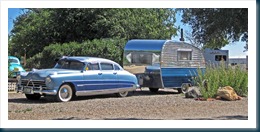
Vintage TrailerOrdinarily when we visit Albuquerque we stay on the east side in Tijeras but this time, in order to be closer to the bead-store-that-isn’t-anymore, we stayed on the west side at a campground on a hill overlooking the entire city.  In addition to campsites, Enchanted Trails RV Park also offers rental units of vintage campers and vintage Hudson cars.  These are arranged around a little garden filled with lilac bushes which would be very pleasant at blossom time.  Campers range from tiny pull-behinds to a very long one that conjured images of Lucy and Desi cavorting beside it.

It’s such a pretty drive from Albuquerque, past Santa Fe and in to Las Vegas (not the one in Nevada, the one in New Mexico).  The highway runs along the foothills of the Sangre de Cristo Mountains on their east flank.  Firs and pines dot the hillsides and recent rains have kept everything green and growing.  Little did we expect that the rain would continue.  Storms begin building up steam in the late afternoon and by dinner time we had several spectacular thunder ‘n lightning shows.  Because the views here are so enormous, we could see where the storm was and where it wasn’t.  It made for some interesting cloud and light patterns but nearby lightning kept us from going outside to try for photos.

The Plaza HotelLas Vegas is a fascinating little city.  Once a hub on the Santa Fe Trail and then again on the AT&SF Railroad, it boasts over 900 buildings on the National Register of Historic Places.  Architectural styles run the gamut from Spanish-influenced adobes to Victorian to Gothic.  Many homes are, sadly, in disrepair and the town is not wealthy enough to do much more than stall the decay.  An Arizona entrepreneur has purchased both the Plaza Hotel on the town plaza (where else would you expect the Plaza to be?) and the La Castaneda Hotel near the railroad tracks.  Castenada HotelThe Plaza is open for business and has been getting rave reviews both for its hotel accommodations and its restaurant.  La Castaneda, on the other hand, is a work barely in progress but we expect in time that it will also be a dazzler.  It was once the gathering place for the first (and for subsequent) reunion of The Rough Riders.  Teddy Roosevelt stayed here when he rejoined his troops in 1899 for the reunion.  As you can see, this restoration is going to be A Very Big Project.

Carnegie - Las VegasUntil 1970 Las Vegas was two cities, separated by the Gallinas River.  The west side, with its Spanish influence, has streets which radiate from the Plaza.  The east side development was influenced by the Easterners who came to town along with the railroad and is laid out in a more traditional grid pattern.  The two different cultures explains the wide variety of architectural styles.  We visited the City Museum, housed in a WPA project building on Grand Avenue and got to see a very nice collection of items belonging to the Rough Riders and to Teddy Roosevelt himself.  The Carnegie Library, vaguely resembling Jefferson’s Monticello, is still in use as the city library.

Film CrewWe were very surprised to learn that Las Vegas has been the location of a number of movies dating back to the silents, through the iconic “Easy Rider”, up to today.  On a second visit to The Plaza we were detoured around to prevent our interfering with filming of an upcoming episode of the television serial “Longmire”.


Madonna CarvingNobody in Las Vegas seems to be in much of a hurry anyhow, so it didn’t matter much that we all, including the actors, stood around waiting patiently for whatever came next.  Finally things cleared enough that we were able to get into position to nab a picture of this folk art carving of the Madonna.  And when the new season of “Longmire” begins, we’ll have to be sure to watch so we can learn how they manage to morph Las Vegas, New Mexico into Durant, Wyoming.
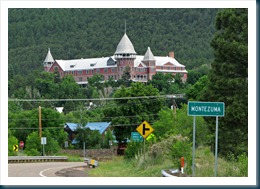
The CastleThe tourist brochures we were given all mentioned Montezuma Castle and we wanted to get a good look at it but the GPS didn’t have a clue where it was.  Nor did it appear on any of the town maps we had.  It was originally built as a destination resort by the Santa Fe Railroad to take advantage of nearby hot springs.  Having gone through a number of incarnations since it closed as a hotel in 1903, it has recently been renovated and serves as the hub for the Armand Hammer United World College, the only United World College in the U.S.  Unfortunately it is closed to visitors except by appointment and so we weren’t able to get close enough to check it out thoroughly.  By the time we located it, in Montezuma not Las Vegas, the clouds had begun to gather for the daily afternoon thunderstorm and so we cut short our exploration and headed home to enjoy Mother Nature’s fireworks display out over The Meadows.

And so we wrapped up our visit to New Mexico, heading up the big hill over Raton Pass and into Colorado.  Our next report will be from Pueblo and points beyond.

Sunday, September 28, 2014

The Dog Days of Summer

With the summer season dwindling down and our energies more or less sapped from a trio of rallies, we installed ourselves at a quiet little campground at Crooked River Ranch.  It’s not easy to describe Crooked River Ranch because there really isn’t any town but rather a sprawling community along the banks (and into the canyon) of the Crooked River.  There’s a golf course and some light industry, some mini-mansions and summer cottages and a whole lot of rugged scenery with sand and sagebrush and the snow-topped Cascades off In the distance.  On the opposite side of the highway is the incredible pile of geologic formations known as Smith Rocks.  And, above all, there is a whole lot of quiet.  And probably more than one rattlesnake.

Crooked River BridgeJust north of the small town of Terrebonne is a scenic overlook which affords a fine view of the Crooked River Gorge.  AdviceThis photo was taken from the “old bridge” toward the “new bridge” and gives some idea just how deep (and narrow) this canyon is.  It’s difficult to imagine that smallish looking river has managed to carve a 600’ deep slit in the earth.  It is equally hard to imagine how many folks managed to ignore this sign!  (Click on photo to enlarge the image.  “Back” button returns to blog).  There is a rock retaining (or should it be restraining?) wall along the canyon edge but it’s not all that tall. 

Alpaca RanchFrom our location in CRR, we made several forays to surrounding towns.  We took the back roads to Sisters to enjoy the scenery and it was there that we came upon this alpaca ranch.  With their wide variety of colors and their oddly sheared bodies, these cute critters made for an arresting display.  Many of the area farm markets sell alpaca yarn and the garments knit from it, all at some pretty darn fancy prices.  But when you consider the hand-work involved in carding and spinning the fibers, it begins to look like a real bargain.  And it feels soooo nice.

BoringLeaving Terrebonne, we headed northwest to Troutdale.  The route took us around Mt. Hood and down into the Columbia River Gorge where we hunkered down to wait out the heavy traffic that Labor Day usually brings.  It has been a number of years since we’ve driven the Old Historic Columbia River Highway and we had hoped to make that tour this year but, alas, forest fires rendered the air hazy for most of our stay and so we contented ourselves with lesser forays.  BrainsOn previous visits we’d more or less explored everything there is to see and so we were just a bit bored….so, what better thing to do than to make a trip to Boring.  And it was.  No false advertising here!  A little further up the road, in the town of Sandy, we came upon the Sandy Historical Museum and discovered this wonderful old photograph.  If brains are that cheap, why don’t we buy up a whole bunch and pass them out gratis to those who appear to be in need of some?

BunniesAnd with Labor Day behind us, we took off for another visit to the Oregon coast with dear friends Gail and Ruthee.  By the time we finished weaving our way over the river and through the woods, they had already made camp and had dinner on the stove so we settled in, chowed down and reveled in the cooler coast temperatures.  Our campground is notorious for its collection of half-domesticated rabbits and they soon came out of hiding and began their I’m-so-cute mooching.  Unlike the wild bunnies of the area, these are not gray but come in a wide range of gaudy colors that could not survive in the wild.  One especially large and aggressive fellow was tricked out like a calico cat in shades of orange and black on a white background.  It wasn’t long before a cute-as-button honey colored little charmer befriended Gail and began a routine of racing to greet him every time he emerged from the coach.  The little beggar even went so far as to try to climb into Gail’s lap.

Abe LincolnOn a trip into Lincoln City we learned about a large bronze statue of Abraham Lincoln, donated by the sculptress when Lincoln City became a city (instead of the five little towns it once was).  But like so many free things, this statue ended up costing the city coffers ‘way more than anticipated since they had to pay for transportation from the East Coast, a spot to display it and routine maintenance on the little park that holds it.  It did give the newly-minted Lincoln City an identity in a way that a new sewer system would not – that was the other project option the city fathers faced.  A sewer system would be inadequate and obsolete by now whereas Abe provides a perfectly fine perch for seagulls and something for tourists to gawk at.

DumbIt must have been Darwin Awards Day on the day we chose to visit Pacific City.  We had  hopes of seeing some of the fishing dories coming ashore full speed ahead.  There’s no dock.  The boats just come ashore like so many landing craft at Normandy.  As we stood wiggling our toes into the hot soft sand, soaking up the sun and enjoying the sea breezes we were able to observe several instances of What-Were-They-Thinking.  Driving on the beach is allowed at Pacific City and access is provided via a paved ramp.  Private vehicles go to the left, tow vehicles for the dories go to the right.  One fishing boat didn’t quite get far enough ashore but the pilot and passengers got out anyhow and were standing around chatting when a bit of rough surf began to haul the empty boat back out into the ocean.  Like a rodeo rider trying to mount a bucking horse, the pilot attempted to climb aboard and very nearly lost the boat completely - not to mention his own life and/or limbs.  Someone was finally able to get aboard, start the engine and take the boat back out into deeper water.  It was later able to land safely in the prescribed dory manner.

Also DumbAs this was all taking place, the driver of a van loaded with senior citizens decided that a drive on the beach would be a lot of fun.  But instead of driving to the hard-packed wet sand, he turned smack into the super soft stuff and promptly sank to the axles.  The old folks with their wheelchairs, walkers and scooters were off-loaded while a tow truck was summoned and the van ingloriously hauled out to solid ground.  We hope the excitement wasn’t too much for any of the passengers.  Because both incidents turned out well, we can laugh about it now but both situations had plenty of potential for serious consequences.

WhaleGail and Ruthee had to head back home after only a week so we were on our own for another few days.  We spent one afternoon whale watching in Depoe Bay and were treated to the sight of several migrating whales close in to shore, spouting and diving and roiling the waters.  Of course it’s nearly impossible to locate them and snap a picture before they’ve submerged, so most of the photos were of bits and pieces emerging from the rather rough surf.  And to wrap up this visit to Oregon, we traveled north to Astoria for a tour of the Lewis and Clark campsite at Fort Clatsop.  Ft. ClatsopFrankly there’s not much to see…just a recreation of the fort and a small museum with replicas of various items associated with the Corps of Discovery.  It never ceases to amaze us how Lewis and Clark managed to get where they were going and safely home again, facing all sorts of dangers, in unknown territory.  Even with the GPS to guide us, we got lost trying to find the fort.

Ft. StevensAlso near Astoria is Fort Stevens State Park, situated on a peninsula at the mouth of the Columbia River.  Built during the Civil War by the Union, the fort remained in service through WWII and was meant to protect the river and her valuable ports.  The coastline near here was actually shelled by Japanese submarines toward the end of WWII.  As you’ll recall, Oregon was also hit by balloon bombs at Bly making it the only state to be “wounded” by the Japanese during that conflict.  Unfortunately most of the military installations at the fort are accessible only on foot and so that precluded much sightseeing on our part.  Neither of us is in good enough shape for such exercise and so we had to content ourselves with the small but interesting museum on the grounds.

Weed SignSo with summer over it became time to begin our trek back to winter quarters in Arizona.  The route chosen took us down I-5 and into California.  Our first planned stop was at Weed, a small community very near Mt. Shasta.  Just three days before our planned arrival, a wildfire ripped through the town, destroying over 100 homes and burning many acres of surrounding forest.  The fire moved fast, spurred on by 40 mph winds.  Ironically, Mr. Weed (for whom the town is named) established his lumber mill here to take advantage of the drying power of the nearly constant wind.  Because of the proximity to the town, the fire was fought very aggressively and was under control in just a few days.  We ascertained that our campground was not affected and by the time we arrived things were as much back to normal as can be expected when such a disaster hits. 

Although the fire came within a block of the Weed Historic Lumber Town Museum its curator Harold Orcutt was open for business on the usual schedule.  LaceTypical of many small town museums, the main collection reflects the town’s major industry but there are also small displays of other things, usually donated by long-time residents of the area.  Harold led us through the exhibits and pointed out some of the more interesting objects, including a gloriously restored American LaFrance fire truck and this nice display of lace collars and other ladies’ finery.  The fur neck piece had a particularly mean expression.  Most of the burned-out areas were not open to non-residents (nor would we wish them to be) but you can see some of the burned trees behind the Weed sign.  Oh yes, and there are plenty of souvenir shops selling all sorts of—snicker, snicker… Weed-themed merchandise.

On a drive northward to visit the Living Memorial Sculpture Garden, we were able to see much more of the burned out area.  The road, which is a pretty heavily traveled truck route, had just been reopened.  There was a police car blocking the entrance to the town cemetery but it looked relatively unscathed.  The perimeter trees were charred but the lawns were green and the gravestones appeared undamaged.

Memorial GardenThe sculpture garden is 13 miles northeast of Weed on Forest Service land and features larger-than-life sculptures by artist Dennis Smith.  The garden is “dedicated to veterans of all conflicts”.  Again, some walking was involved to get up close to the statues so I opted to wait near the car.  (Need I mention that the high desert landscape looked like prime rattler territory to me.)

And that brings us to the Sacramento River Delta.  It’s raining and I’m watching a neighbor trying to load a big Harley into a small truck.  Stay tuned for the results.  Right now it doesn’t look good.